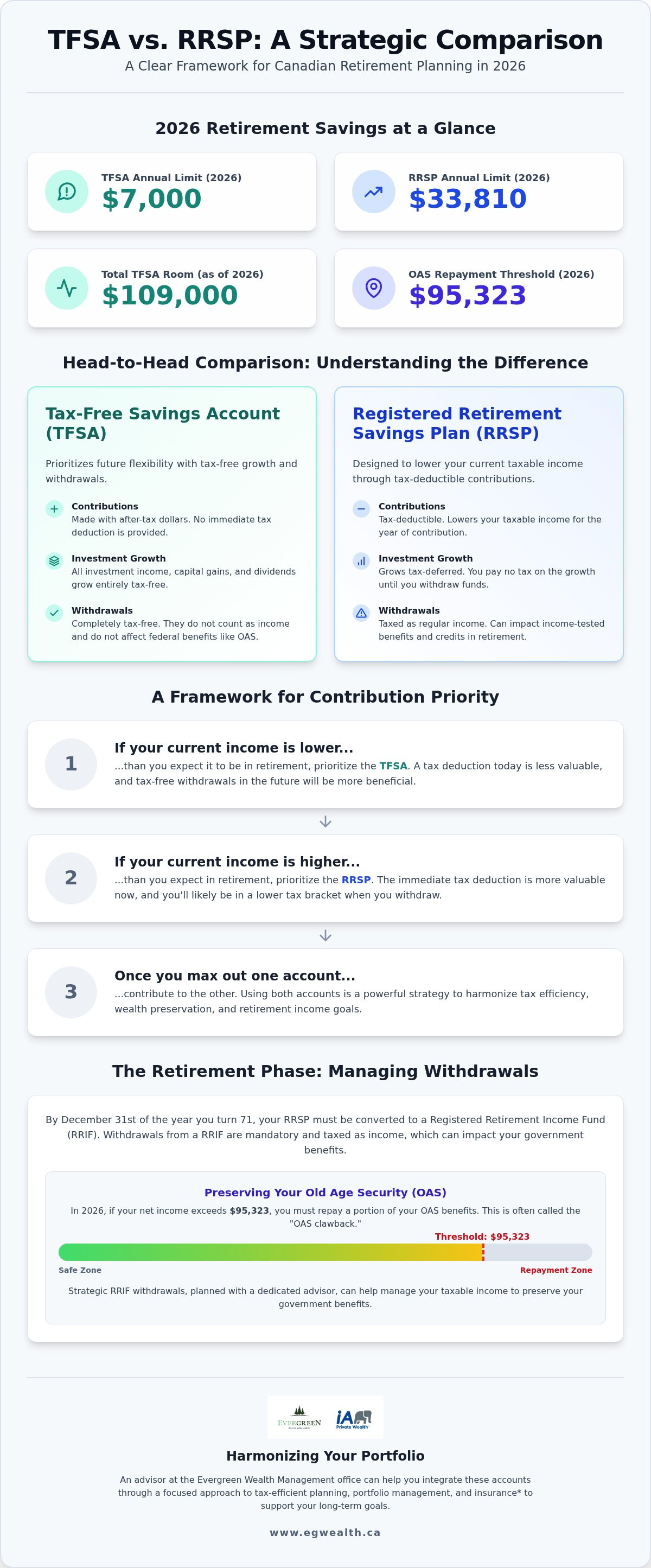
What if the tax refund you receive today is actually a quiet loan from your future self that you’ll eventually repay with interest? Deciding between a TFSA vs RRSP for retirement planning in Canada often feels like a choice between two competing philosophies: the immediate relief of a tax break today or the quiet confidence of tax-free growth tomorrow. It’s natural to feel a sense of hesitation as you look at the evolving financial landscape. With the TFSA annual contribution limit holding at C$7,000 in 2026, bringing the total cumulative room to C$109,000 as of 2026, the potential for growth is significant. However, the RRSP limit of C$33,810 for 2026 remains a powerful tool for those looking to lower their current taxable income.

At Evergreen Wealth Management, iA Private Wealth, we recognise that your journey is deeply personal. We promise to help you discover the strategic differences between these accounts to optimise your tax efficiency and wealth preservation throughout your retirement. This guide provides a clear framework for contribution priority, helping you lower tax bills and manage the OAS repayment threshold of C$95,323 in 2026. An advisor in our office can help you harmonise these tools, integrating portfolio management and insurance* to support your long-term goals. We’ll begin by evaluating how current income levels dictate your ideal savings path, moving toward a structured approach for your legacy.

Key Takeaways

  • Learn how to balance the tax-deferred growth of an RRSP with the tax-free status of a TFSA to support long-term wealth preservation.
  • Discover a clear framework for TFSA vs RRSP for retirement planning Canada by evaluating your current tax bracket against your expected income in retirement.
  • Identify how to maximize your contributions for the 2026 tax year, utilizing the C$7,000 TFSA limit and the C$33,810 RRSP maximum for 2026.
  • Uncover strategies to manage RRIF withdrawals effectively while remaining below the OAS repayment threshold of C$95,323 in 2026 to preserve your government benefits.
  • Understand how an advisor at Evergreen Wealth Management can harmonize your portfolio through a focused approach to tax-efficient planning and insurance*.

The Landscape of Canadian Retirement Savings: Defining the TFSA and RRSP

Retirement planning in Canada is less about choosing a single account and more about crafting a strategy that evolves with your life. An advisor at Evergreen Wealth Management views the choice of TFSA vs RRSP for retirement planning in Canada as a harmony between two powerful vehicles. Instead of viewing them as competitors, we see them as partners in a broader mission of wealth preservation and creating tax-efficient cash flow. By understanding the unique mechanics of each, you can build a foundation that supports your lifestyle through every season of transition. This approach helps reduce the noise of the market, allowing you to focus on the human element of your long-term journey. Our office focuses on streamlining these choices, so that your wealth remains a tool for your comfort rather than a source of confusion.

Understanding the RRSP Framework

The Registered Retirement Savings Plan (RRSP) is a cornerstone of Canadian retirement strategy, primarily designed to lower your current taxable income. When you contribute, you are admissible to a tax deduction, which can be particularly advantageous during your peak earning years. This deduction effectively returns a portion of your income to you, which can then be reinvested to further support your growth. Investment growth within the account remains tax-deferred; you won’t pay taxes on capital gains or dividends as they accrue. However, this tax obligation is deferred, not eliminated. For the 2026 tax year, the RRSP dollar limit is C$33,810. By December 31 of the year you turn 71, federal regulations require you to convert your RRSP into a Registered Retirement Income Fund (RRIF) or purchase an annuity. This transition marks the shift from accumulation to a structured withdrawal phase where payments are taxed as regular income.

The Evolving Role of the TFSA

While the RRSP focuses on the present tax break, the Tax-Free Savings Account (TFSA) prioritizes future flexibility. You make contributions with after-tax dollars, so there is no immediate deduction to claim. The trade-off is profound: every dollar of investment income and every withdrawal remains entirely tax-free. This creates a versatile pool of capital that doesn’t trigger tax liabilities or impact income-tested benefits. As of 2026, the total cumulative TFSA contribution room for people who haven’t contributed and who turned 18 before 2009 is C$109,000. With the annual limit set at C$7,000 in 2026, this significant capacity allows for substantial wealth preservation without the weight of future tax bills. Our practice focuses on how these accounts work together, often integrating insurance* to provide an additional layer of support for your estate.

Tax Efficiency and Contribution Frameworks for 2026

Timing your contributions is just as vital as the amount you save. While both accounts offer tax-advantaged growth, the immediate impact on your cash flow differs significantly. Choosing between a TFSA vs RRSP for retirement planning in Canada requires an understanding of how today’s tax savings compare to tomorrow’s tax-free withdrawals. If you’re in your peak earning years, the RRSP’s immediate deduction can feel like a welcome relief. However, if you anticipate being in a similar or higher tax bracket during retirement, the long-term tax-free status of the TFSA often becomes the more efficient choice for wealth preservation. Our office focuses on analyzing these variables to help you decide which path supports your unique journey.

RRSP Contribution Limits and Rules for 2026

For the 2026 tax year, the RRSP dollar limit is C$33,810, as noted by the Canada Revenue Agency. It’s important to remember that your actual contribution room is restricted to 18% of your earned income from the previous year, minus any pension adjustments, up to that maximum cap. Many high-income professionals use a strategy called tax bracket shifting. This involves making contributions during high-income years to drop into a lower tax bracket, effectively generating a larger tax refund. If you have unused room from previous years, it carries forward indefinitely, providing a powerful tool for years when your income spikes. To see how these rules apply to your specific situation, you can speak with an advisor at our office for a personalized review.

TFSA Contribution Limits and Rules for 2026

The annual TFSA contribution limit for 2026 is C$7,000. Unlike the RRSP, your TFSA room isn’t tied to your income level; it’s a flat amount available to every eligible Canadian resident. One of the most flexible features of this account is the treatment of withdrawals. If you take money out of your TFSA, that exact amount is added back to your available contribution room in the following calendar year. This allows you to maintain liquidity and access your capital for unexpected life transitions without triggering a tax bill or losing your contribution space forever. In a comprehensive plan, the TFSA acts as a tax-free reservoir, helping you manage your taxable income levels and support your lifestyle without the worry of future tax liabilities. By integrating these accounts with a focused approach to insurance*, we can help you build a strategy that prioritizes continuity and calm.

The core of the TFSA vs RRSP for retirement planning in Canada debate lies in a comparison between your current marginal tax bracket and the one you expect to occupy during retirement. If you’re currently in a high tax bracket, the RRSP offers a significant advantage by allowing you to deduct contributions from your taxable income today. Conversely, if you’re early in your career or in a lower tax bracket, the TFSA often serves as the more efficient tool, as it preserves your future income from being taxed at all. An advisor at Evergreen Wealth Management focuses on this balance, helping to keep your strategy steady as your career and income levels evolve.

Strategies for High-Income Earners

For those in peak earning years, the RRSP deduction is a powerful lever. By contributing to an RRSP, you can effectively move into a lower tax bracket, generating a tax refund that reflects your high marginal rate. A sophisticated approach involves reinvesting that refund directly into a TFSA. This creates a "double-compounding" effect where the initial tax savings fuel further tax-free growth. However, high-income earners must be mindful of the "tax time bomb" associated with large RRIF balances. Mandatory withdrawals later in life can push your income above the OAS repayment threshold of C$95,323 in 2026. Our practice helps you manage this risk by structuring withdrawals to support your lifestyle without sudden tax spikes.

Flexibility for Lower or Middle-Income Brackets

If your current income is modest but you expect it to grow, prioritizing the TFSA is often the most logical step. This approach allows you to save RRSP room for future years when your income, and the resulting tax deduction, will be more valuable. Additionally, TFSA withdrawals don’t count as taxable income, meaning they won’t impact income-tested government benefits. This flexibility is essential for maintaining a sense of calm during life transitions. Using your TFSA contribution room, you can build a significant tax-free reservoir while keeping your capital accessible for unexpected expenses without a permanent loss of contribution room. Our office is dedicated to simplifying these complexities, helping you choose the path that feels most intentional for your long-term journey.

The Decumulation Phase: RRIF Conversion and Government Benefits

The transition from saving to spending is a significant life milestone that requires a shift in mindset. While the accumulation years focused on growth, the decumulation phase is about creating a steady, tax-efficient stream of income to support your lifestyle. This is where the strategy for TFSA vs RRSP for retirement planning in Canada truly shows its value. It’s a shift from accumulation to a structured drawdown that prioritizes your cash flow needs. An advisor at Evergreen Wealth Management can help you navigate this transition, providing a calm perspective as you move into this new chapter. Our practice focuses on streamlining these choices so that your wealth remains a tool for your comfort.

Managing the OAS Repayment Threshold in 2026

The Old Age Security (OAS) pension is a cornerstone of Canadian retirement, but its benefits are income-tested. The OAS repayment threshold is C$95,323 in 2026. If your net income exceeds this amount, you’ll face a recovery tax of 15 cents for every dollar above the limit. This is where the TFSA becomes an invaluable tool for wealth preservation. Since TFSA withdrawals aren’t considered taxable income, they don’t count toward the calculation that triggers a clawback. By using tax-free TFSA income to supplement your cash flow, you can support your lifestyle while keeping your taxable income below the threshold. Our office is focused on modelling different withdrawal scenarios to help you stay within these limits, often integrating insurance* to provide additional layers of support for your estate.

The RRIF Conversion Milestone

By December 31 of the year you turn 71, federal law requires you to convert your RRSP into a Registered Retirement Income Fund (RRIF) or an annuity. This transition introduces mandatory minimum withdrawal rates that increase as you age. These withdrawals are fully taxable and can significantly impact your annual tax bill. In some cases, it’s beneficial to begin depleting RRSP assets earlier than required to avoid a larger tax burden later in life. This proactive approach supports your long-term wealth preservation and helps integrate your CPP and OAS strategy with your registered account drawdowns. If you’re approaching this milestone, you can connect with our office to discuss a plan that aligns with your goals.

TFSA vs RRSP: Retirement Planning in Canada (2026)

Harmonizing Your Portfolio with Evergreen Wealth Management

A truly effective strategy moves beyond the simple selection of account types. It requires a holistic view that integrates tax planning, cash flow, and long-term legacy goals. When considering the role of a TFSA vs RRSP for retirement planning in Canada, you must look at how these tools interact within your broader financial landscape. At Evergreen Wealth Management, we focus on creating a unified approach to retirement portfolio management in Canada. Our office is dedicated to simplifying these complex decisions, providing a steady hand as you navigate the transitions of later life. By looking at your wealth through a wider lens, an advisor in our practice can help you move from accumulation to a phase of intentional preservation.

Estate Planning and Beneficiary Designations

The choice of which account to deplete first often depends on your estate goals. Upon the death of the account holder, an RRSP or RRIF is generally treated as if the entire balance was earned as income in that final year. This can trigger a significant tax bill, potentially claiming nearly half of the account’s value before it reaches your heirs. In contrast, the TFSA offers a much more streamlined transfer of wealth. By naming a spouse as a successor holder, the account can move to them while maintaining its tax-free status and without affecting their own contribution room. Our practice helps you evaluate these tax implications, helping you preserve the value of your estate through professional tax and cash flow planning. We focus on helping you decide which assets to draw from first to minimize the terminal tax burden on your legacy.

The Role of Insurance* in Wealth Preservation

Insurance* serves as a vital tool for those who wish to support the full value of their hard-earned assets for the next generation. A terminal RRIF balance often represents one of the largest tax liabilities a Canadian will ever face. Our office uses insurance* with the aim of providing the necessary liquidity to cover these taxes. This focused approach aims to allow your legacy to remain intact, providing comfort for your loved ones. For a deeper look at how these strategies evolve, consult our guide to insurance* for retirement in Canada (2026). An advisor at Evergreen Wealth Management can help you integrate these solutions into a cohesive plan that prioritizes order and calm throughout your retirement journey.

Cultivating Your Financial Legacy

The journey toward a fulfilling retirement is built on intentional choices made today. Harmonizing a TFSA vs RRSP for retirement planning in Canada isn’t about finding a one-size-fits-all answer; it’s about aligning your savings with your unique income path and estate goals. By understanding how to manage current tax deductions alongside future tax-free withdrawals, you can navigate life’s transitions with a sense of calm and order. Whether you’re optimizing for the 2026 contribution limits or preparing to manage the OAS repayment threshold, a structured approach is essential for long-term wealth preservation.

Our office is dedicated to simplifying the Canadian tax landscape through tailored strategies for tax and cash flow planning. We focus on retirement planning that prioritizes the human element of your story. If you’re ready to move beyond account definitions toward a holistic plan that integrates portfolio management and insurance*, we invite you to take the next step. Connect with an advisor at Evergreen Wealth Management to refine your retirement strategy and support the future you’ve worked so hard to build. Your path forward should be as steady and enduring as the legacy you intend to leave behind.

Frequently Asked Questions

Is it better to put money in a TFSA or an RRSP for retirement in Canada?

The choice between a TFSA vs RRSP for retirement planning in Canada depends on your current income compared to your expected income in retirement. Generally, if you’re in a high tax bracket today, the RRSP deduction provides immediate relief. However, if you’re in a lower bracket or anticipate your income rising, the TFSA offers tax-free growth that won’t trigger future tax liabilities. An advisor at our office can help you model these scenarios to support your long-term wealth preservation.

What is the TFSA contribution limit for the 2026 tax year?

The TFSA annual contribution limit for 2026 is C$7,000. If you’ve been eligible since the program’s inception in 2009, your total cumulative room reaches C$109,000 as of 2026. This capacity allows for significant tax-free growth, helping you preserve your capital for future life transitions. Any withdrawals you make are added back to your contribution room in the following calendar year, providing a level of flexibility that supports your ongoing cash flow needs.

Can I have both a TFSA and an RRSP at the same time?

Yes, you can hold both a TFSA and an RRSP simultaneously, and many Canadians find that using them together is the most effective approach. These accounts work in harmony to address different financial goals and tax situations. While the RRSP focuses on lowering your current taxable income, the TFSA provides a reservoir of tax-free capital. Evergreen Wealth Management focuses on harmonizing these tools, often integrating portfolio management and insurance* to build a comprehensive plan that prioritizes your peace of mind.

How do RRSP withdrawals affect my OAS benefits in 2026?

RRSP withdrawals are treated as taxable income, which can push your total earnings toward the OAS repayment threshold of C$95,323 in 2026. If your income exceeds this limit, you face a 15% recovery tax on the excess amount. Strategic planning involves balancing these withdrawals with tax-free TFSA income to keep your taxable earnings below the threshold. Our practice is dedicated to simplifying these complexities, helping you preserve your government benefits through intentional cash flow planning.

What happens to my RRSP when I turn 71?

By December 31 of the year you turn 71, federal regulations require you to close your RRSP and either convert it into a Registered Retirement Income Fund (RRIF) or purchase an annuity. This transition marks the shift from saving to a structured withdrawal phase. Once converted to a RRIF, you must take a mandatory minimum amount each year, which is taxed as regular income. An advisor at Evergreen Wealth Management can help you navigate this milestone to support your lifestyle goals.

Are TFSA withdrawals considered taxable income in Canada?

No, TFSA withdrawals are not considered taxable income and don’t need to be reported on your Canadian tax return. This tax-free status is one of the primary advantages of the account, as it allows you to access your wealth without triggering a tax bill or affecting income-tested government benefits like OAS. Using the TFSA vs RRSP for retirement planning in Canada provides a flexible way to manage your tax bracket in retirement while supporting your overall wealth preservation strategy.

Can I use my TFSA or RRSP for a down payment on a home?

You can use both accounts for a down payment, though the rules differ significantly. The TFSA allows you to withdraw any amount at any time without tax consequences or repayment requirements. For the RRSP, the Home Buyers’ Plan (HBP) lets you withdraw up to C$60,000 tax-free, provided the funds are used for a first home and repaid over 15 years. Our office focuses on helping you evaluate which account to use first to support your homeownership goals while preserving your retirement path.

What is the maximum RRSP contribution for 2026?

The maximum RRSP contribution limit for 2026 is C$33,810. However, your individual limit is restricted to 18% of your earned income from the previous tax year, minus any pension adjustments, up to that dollar cap. If you haven’t maximized your contributions in previous years, your unused room carries forward indefinitely. This allows you to make larger contributions in years when your income is higher, effectively lowering your tax bracket and supporting your long-term wealth preservation goals.

Article by

Rodney Anton

Rodney Anton is a Portfolio Manager, Senior Investment Advisor at Evergreen Wealth Management | iA Private Wealth, and an Insurance Advisor* at Evergreen Wealth Management Inc. He works with executives, professionals, and business owners to help coordinate investment strategy, tax planning, retirement income, and long-term wealth creation. Rodney focuses on building practical, personalized financial strategies that help clients preserve what they have built while identifying opportunities for growth.

Disclaimer

This information has been prepared by Rodney Anton who is a Portfolio Manager for iA Private Wealth Inc. and does not necessarily reflect the opinion of iA Private Wealth. The information contained in this article comes from sources we believe reliable, but we cannot guarantee its accuracy or reliability.

The opinions expressed are based on an analysis and interpretation dating from the date of
publication and are subject to change without notice. Furthermore, they do not constitute an
offer or solicitation to buy or sell any of the securities mentioned. The information contained
herein may not apply to all types of investors.

This content was fully or partially generated by artificial intelligence. The advisor reviewed the critical information independently.

iA Private Wealth Inc. is a member of the Canadian Investor Protection Fund and the Canadian
Investment Regulatory Organization. iA Private Wealth is a trademark and a business name
under which iA Private Wealth Inc. operates

*Insurance products and services are offered through Evergreen Wealth Management Inc., an
independent and separate company from iA Private Wealth Inc. Only products and services offered through iA Private Wealth Inc. are covered by the Canadian Investor Protection Fund

Discover more from Evergreen Wealth Management

Subscribe now to keep reading and get access to the full archive.

Continue reading