What if your mandatory RRIF minimum was actually the least efficient way to draw from your retirement savings? Many Canadian retirees view their Registered Retirement Income Fund as a fixed obligation, yet treating it as a dynamic tax-bracket management tool can be the difference between a high tax bill and a refined lifestyle. You’ve likely felt the concern that high marginal tax rates might erode your hard-earned savings. Implementing effective RRIF withdrawal strategies Canada requires a shift from simple compliance to intentional optimization within your financial practice.

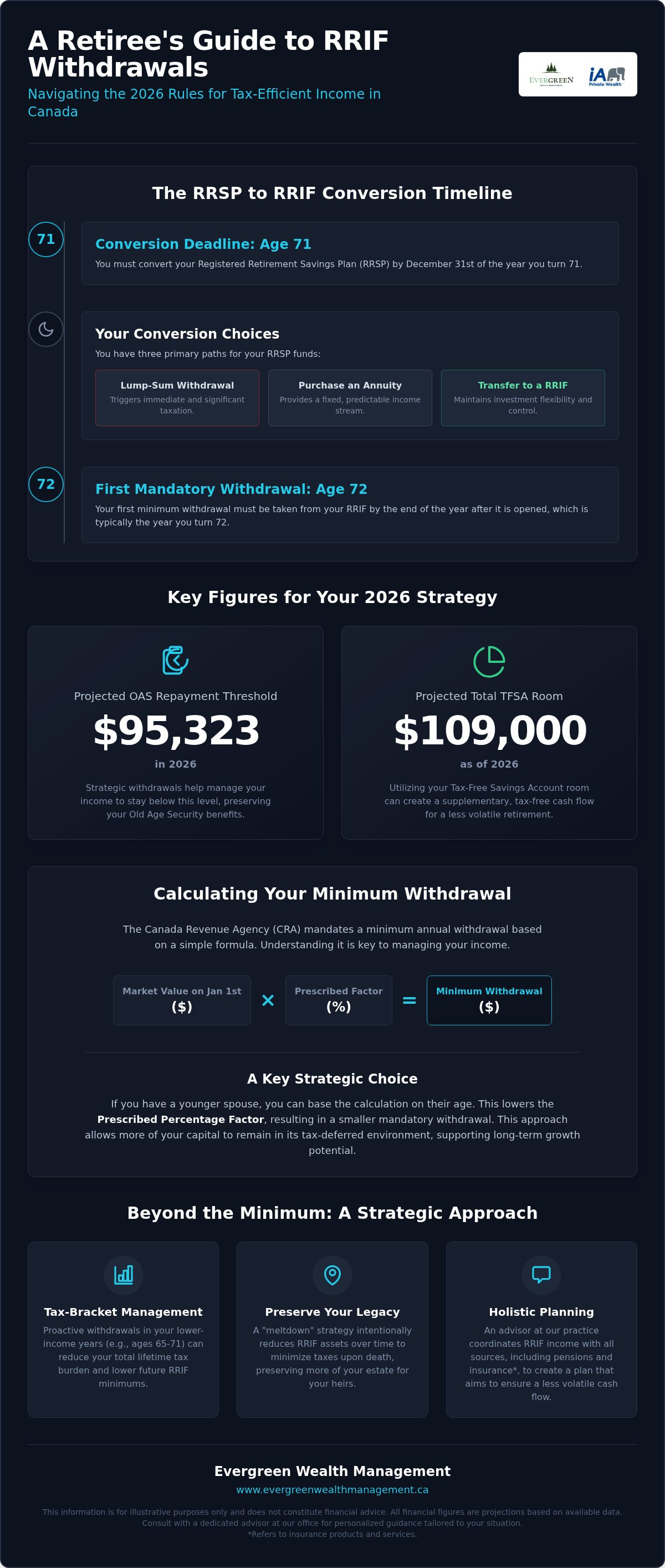
At Evergreen Wealth Management, our dedicated advisors believe that clarity is the foundation of peace of mind. You’ll learn how to navigate the 2026 RRIF withdrawal rules and implement tax-efficient strategies that support your long-term vision. We’ll explore how to manage the OAS repayment threshold, which is projected to be $95,323 in 2026, and how to utilize your total TFSA room of $109,000 as of 2026 to create a less volatile retirement cash flow. By focusing on precision, this guide aims to ensure you preserve your capital for heirs and integrate tools like estate-focused insurance* to streamline your legacy.

Key Takeaways

  • Learn the specific timeline for converting your RRSP by age 71 and the requirements for your first mandatory withdrawal by age 72.
  • Discover how to implement RRIF withdrawal strategies Canada like the “meltdown” method to reduce your future tax burden and preserve your wealth.
  • Understand how to manage the OAS repayment threshold of $95,323 in 2026 through strategic income splitting and tax-bracket optimization.
  • See how an advisor at Evergreen Wealth Management can simplify complex CRA rules to create a retirement plan that aims to ensure a less volatile cash flow through portfolio management and insurance*.

Understanding the RRIF Transition: Rules and Requirements for 2026

Retirement is often viewed as a single destination, yet it’s truly a series of intentional transitions. The shift from a Registered Retirement Savings Plan (RRSP) to a Registered Retirement Income Fund (RRIF) represents a significant milestone in this journey. Think of the RRIF as the natural evolution of your savings; it’s designed to provide a steady stream of income while allowing your remaining assets to continue growing tax-deferred. Unlike an RRSP, you can’t contribute new capital once the account is established, but the underlying investments remain within a tax-sheltered environment until you draw them out.

Many dedicated professionals choose to initiate this transition earlier than required. While the law mandates conversion by age 71, starting sooner can be a cornerstone of effective RRIF withdrawal strategies in Canada. By drawing income in lower tax brackets before mandatory minimums kick in, you can often reduce the total tax paid over your lifetime. This proactive approach helps support a less volatile financial trajectory as you move into your post-work years.

The Conversion Timeline: From RRSP to RRIF

You must finalize your RRSP conversion by December 31 of the year you turn 71. According to CRA guidelines, you have three primary paths to consider:

  • Withdrawing the entire balance as a lump sum, which triggers immediate, heavy taxation.
  • Purchasing an annuity to provide a fixed income stream.
  • Transferring the funds directly into a RRIF to maintain investment control.

Most Canadians prefer the RRIF transfer because it maintains investment flexibility, allowing you to manage your portfolio according to your personal risk tolerance. Your first mandatory withdrawal must then be taken by the end of the year you turn 72, though you can always choose to take more than the minimum if your lifestyle requires it.

Why 2026 is a Critical Year for Your Retirement Strategy

The economic environment of 2026 demands a more sophisticated lens for cash flow planning. With shifting tax brackets and rising costs of living, simply taking the minimum withdrawal might not be enough to preserve your long-term wealth. For instance, managing your income to stay below the OAS repayment threshold, which is projected to be $95,323 in 2026, is a key consideration for many retirees. A core pillar of a successful plan involves minimizing tax in retirement in Canada through precise timing and the use of all available credits.

An advisor at Evergreen Wealth Management can help you implement refined RRIF withdrawal strategies in Canada by aligning your income with your lifestyle needs and legacy goals. Our practice focuses on transforming cold institutional data into a bespoke strategy that aims to ensure your retirement remains as fulfilling as you envisioned. By coordinating your RRIF income with other sources, including potential insurance* solutions for estate planning, we work to prevent unnecessary tax spikes and support your family’s financial continuity.

Calculating Minimum Withdrawals and Tax Obligations

Understanding the mathematical foundation of your RRIF is the first step toward a refined cash flow plan. The Canada Revenue Agency (CRA) mandates a minimum amount that you must withdraw every year, starting the year after you establish the fund. This requirement is designed to ensure that tax-deferred savings are eventually brought into your taxable income. However, the exact amount isn’t static; it’s a moving target based on your age and the total market value of your account on January 1 of each year. Because the value at the start of the year dictates your obligation, market volatility can create unexpected shifts in your required income for 2026.

Selecting the right RRIF withdrawal strategies in Canada often begins with deciding whose age to use for the calculation. If you have a younger spouse, you can base your minimum withdrawals on their age, which results in a lower mandatory drawdown. This choice can be vital for those who wish to preserve more capital within the tax-sheltered environment for as long as possible. Our advisors at Evergreen Wealth Management often suggest this route for clients who have other income sources and don’t require the full RRIF minimum to support their lifestyle.

The RRIF Minimum Withdrawal Formula

For individuals who convert their RRSP before age 71, the formula is 1 divided by (90 minus your current age). Once you reach age 71, the CRA applies a fixed percentage schedule. These percentages increase as you age, reflecting a structured depletion of the account. For 2026, the withdrawal factors remain consistent with the CRA’s established RRIF factors. Below is a sample of the percentages required for ages 72 through 80:

Age (on Jan 1) Minimum Withdrawal Percentage
72 5.40%
73 5.53%
74 5.67%
75 5.82%
76 5.98%
77 6.17%
78 6.36%
79 6.58%
80 6.82%

Withholding Tax vs. Marginal Tax

It’s a common misconception that the tax withheld at the time of withdrawal is your final tax bill. For any amount taken above the mandatory minimum, financial institutions are required to apply a withholding tax. In 2026, these rates are 10% for amounts up to $5,000, 20% for amounts between $5,001 and $15,000, and 30% for anything exceeding $15,000. Think of this as a pre-payment toward your annual taxes.

Your actual tax obligation is determined by your total marginal tax rate, which includes both federal and provincial tax brackets. If your total income for the year is high, the 30% withheld might not be enough, leading to a balance due in April. Conversely, if your income is lower, you might receive a refund. To avoid surprises, it’s helpful to review your various retirement income streams Canada to balance your total exposure. If you’re unsure how these tiers impact your specific situation, you can connect with our practice for a personalized review that aims to ensure your cash flow remains less volatile.

Five Strategic Methods to Optimize RRIF Income

Developing a plan for your retirement income requires more than just meeting the minimum requirements. By applying intentional RRIF withdrawal strategies in Canada, you can create a more efficient cash flow that supports your lifestyle while minimizing the erosion of your assets. These methods move beyond simple compliance, focusing on how to align your withdrawals with your broader financial ecosystem. At Evergreen Wealth Management, our advisors prioritize a refined approach that balances immediate needs with long-term wealth preservation.

The Spousal Age Election

When you establish your RRIF, you have a unique opportunity to base your minimum withdrawals on the age of a younger spouse or common-law partner. This election must be made at the time the account is opened and cannot be changed later. By choosing the younger age, you lower the mandatory percentage you must withdraw each year. This aims to ensure more capital remains in the tax-sheltered environment, allowing it to grow for a longer period. It’s a powerful tool for couples with a significant age gap, and importantly, it doesn’t limit your ability to use pension income splitting to optimize your household tax bill.

Another approach is the "Meltdown" strategy. This involves withdrawing more than the mandatory minimum in your early retirement years, specifically when you’re in a lower tax bracket. By intentionally drawing down the RRIF balance now, you reduce the size of the fund that will eventually be subject to much higher mandatory withdrawal rates in your 80s and 90s. This proactive drawdown helps prevent a tax spike later in life, contributing to a less volatile financial legacy and supporting your ability to preserve capital for your heirs. For a broader look at how this fits into a complete income plan, our guide on tax efficient retirement income for 2026 explores the full withdrawal hierarchy and how to coordinate multiple income sources.

RRIF to TFSA: Keeping Your Wealth Tax-Free

If you don’t need your full RRIF withdrawal for daily expenses, consider moving the excess directly into a Tax-Free Savings Account (TFSA). For those who have been eligible since the program’s inception, the total TFSA room as of 2026 is $109,000. Transferring funds here allows your wealth to continue growing without any future tax obligations upon withdrawal. To avoid unnecessary transaction costs, you can often perform an in-kind transfer. This allows you to move stocks or mutual funds directly from your RRIF to your TFSA or a non-registered account without selling the underlying assets, maintaining your market exposure while satisfying CRA requirements.

Finally, consider the timing of your income. While many retirees default to an annual lump sum, setting up monthly or quarterly payments can mirror the rhythm of a regular paycheque. This methodical approach simplifies budgeting and allows your remaining investments more time to potentially recover from short-term market dips. An advisor at Evergreen Wealth Management can help you determine which of these five methods best supports your unique goals, refining your plan as your needs evolve over time to include considerations like estate-focused insurance* or charitable giving.

Preserving Wealth through Advanced Tax-Bracket Management

Achieving a refined retirement requires a delicate balance between drawing income and preserving your eligibility for government benefits. Without a structured plan, your RRIF can become a double-edged sword, providing necessary cash flow while inadvertently triggering higher taxes or benefit reductions. Implementing sophisticated RRIF withdrawal strategies in Canada allows you to maintain control over your marginal tax rate, keeping more of your wealth for your lifestyle and legacy. This level of coordination is what transforms a simple retirement fund into a powerful tool for long-term financial continuity.

Avoiding the OAS Clawback

The Old Age Security (OAS) clawback, officially known as the recovery tax, is a primary concern for many high-income retirees. For the 2026 tax year, the OAS repayment threshold is $95,323 in 2026. If your net world income exceeds this amount, you’ll be required to repay 15 cents for every dollar above the limit. Strategic RRIF drawdowns can help mitigate this. For instance, taking larger withdrawals in the years before your OAS payments begin can reduce the total size of your RRIF. This proactive approach lowers future mandatory minimums, which often helps you stay below the threshold once your government benefits are in full swing.

An advisor in our office can help you model these scenarios for 2026, identifying the "sweet spot" where you maximize your income without sacrificing your benefits. By looking ahead, we can help you decide if accelerating RRIF payments today is a more efficient path than facing a significant clawback in your 80s. This foresight aims to ensure your government benefits remain a supportive pillar of your retirement rather than a source of tax anxiety.

Income Splitting for Retirees

Income splitting remains one of the most effective tools for reducing a household’s total tax bill. If you’re age 65 or older, Canadian tax rules allow you to split up to 50% of your RRIF income with your spouse or common-law partner. By shifting income from a higher-earning spouse to a lower-earning one, you can often drop into a more favourable tax bracket. This strategy also allows both partners to claim the Pension Income Tax Credit of $2,000 in 2026, effectively doubling the tax savings for the couple.

Coordinating these withdrawals with the timing of your Canada Pension Plan (CPP) and OAS is essential for a less volatile total income. Our practice focuses on how these different streams interact, including the role of estate-focused insurance* in your broader strategy. If you’re ready to see how these pieces fit together for your specific situation, reach out to our practice today for a dedicated consultation that prioritizes your peace of mind.

RRIF Withdrawal Strategies in Canada: A 2026 Guide to Tax Efficiency

Designing a Personalized RRIF Strategy with Evergreen Wealth Management

The transition from saving to spending is one of the most profound shifts in your financial life. While the rules governing RRIF withdrawal strategies in Canada are universal, your personal goals, family dynamics, and legacy aspirations are entirely unique. Navigating these complexities requires more than just a calculation; it demands a partnership with a team that values your peace of mind. At Evergreen Wealth Management, our advisors act as a calm in the storm, helping you organize the intricate details of your cash flow into a clear, intentional methodology.

Unlike the generic advice often found at larger institutions, our practice focuses on a bespoke mindset. We believe that every action should be part of a larger, well-considered strategy. This means coordinating your RRIF withdrawals with portfolio management that prioritizes wealth preservation. By selecting assets that support a less volatile retirement fund, we work to reduce the anxiety often associated with market fluctuations and mandatory drawdowns. We take the time to understand your vision, aiming to ensure your financial plan evolves alongside your life.

The Evergreen Wealth Management Approach

Our approach is rooted in professional pre and post retirement planning. We go beyond the basics of tax and cash flow planning to integrate estate planning and insurance* into your broader strategy. For many of our clients, preserving capital for heirs is just as important as generating current income. By utilizing tools like estate-focused insurance*, we can help streamline the transfer of wealth and support your family’s financial continuity. This level of thoroughness aims to ensure your legacy goals are met while providing you with the clarity you need to enjoy your retirement years fully.

Next Steps: Supporting Your Financial Future

As you look toward the upcoming tax year, it’s the perfect time to review your current retirement plan. The rules and thresholds are constantly evolving, and a strategy that worked yesterday may no longer be the most efficient path for 2026. A consultation with an advisor in our practice can help you refine your RRIF withdrawal strategies in Canada, aiming to ensure they remain aligned with your current lifestyle and future goals. We’ll work with you to analyze your cash flow, manage tax exposure, and support your wealth preservation objectives.

If you’re still in the process of determining the best fit for your needs, we recommend reading our guide on choosing a financial advisor. This resource provides a framework for selecting a partner who understands the nuances of retirement planning in Canada. When you’re ready for a more personal conversation, our team is here to help you move from vision to execution, providing the dedicated support you deserve as you navigate this significant life transition.

Cultivating a Legacy through Intentional Planning

Transitioning into the withdrawal phase of retirement marks a shift from accumulation to preservation. You’ve seen how refined RRIF withdrawal strategies in Canada can transform a mandatory obligation into a sophisticated tool for tax efficiency. Whether you’re leveraging a younger spouse’s age to lower minimums or managing your total income to stay below the repayment thresholds discussed, every decision supports your long-term vision. These choices don’t just impact your tax bill; they define the rhythm of your retirement lifestyle.

At Evergreen Wealth Management, we’ve provided dedicated tax and cash flow planning since our inception. Our practice focuses on professional wealth management that aims to ensure a less volatile future through bespoke estate planning and insurance* solutions. We’re here to help you navigate complex CRA rules with clarity and composure, transforming cold data into a personal roadmap. By focusing on the human element, we work to preserve your capital for the people and causes that matter most. To deepen your understanding of how to structure withdrawals across all your accounts, explore our comprehensive resource on tax efficient retirement income strategies for 2026.

Connect with a dedicated advisor at Evergreen Wealth Management to optimize your RRIF strategy. We look forward to helping you realize a retirement that feels both organized and fulfilling.

Frequently Asked Questions

Can I change my RRIF withdrawal amount once I have started?

Yes, you can change your withdrawal amount at any time, provided you meet the annual minimum requirement set by the CRA. While the minimum is fixed based on your age, you’re free to take larger lump sums or increase your monthly payments to suit your lifestyle. Adjusting your income is a key part of RRIF withdrawal strategies in Canada, allowing you to respond to shifting needs or market conditions throughout 2026.

What happens to my RRIF if I pass away?

Upon death, the fair market value of your RRIF is generally treated as income on your final tax return, which can result in a significant tax bill for your estate. However, if you name a qualified survivor such as a spouse or a financially dependent child with a disability as the beneficiary, the funds can often be rolled over tax-deferred. An advisor can help you integrate insurance* to support your heirs and preserve the value of your legacy.

Is it better to take the RRIF minimum or more than the minimum in 2026?

Deciding whether to take more than the minimum in 2026 depends on your current marginal tax rate and your long-term goals. If you’re in a lower tax bracket now but expect higher mandatory withdrawals later, taking extra income today can reduce the fund’s future size and total tax liability. This strategy helps support a less volatile tax profile over your lifetime, especially if you’re managing the OAS repayment threshold of $95,323 in 2026.

How does RRIF income affect my eligibility for the Guaranteed Income Supplement (GIS)?

RRIF income is considered taxable income and will directly reduce your eligibility for the Guaranteed Income Supplement (GIS). Since GIS is based on net income thresholds, every dollar taken from your RRIF can decrease your supplement by up to 50 cents. If you rely on GIS, it’s vital to coordinate your withdrawals with an advisor to realize the most efficient income mix.

Can I transfer my RRIF back to an RRSP if I am under 71?

Yes, you can transfer RRIF assets back into an RRSP as long as you’re age 71 or younger. This is often done if a retiree returns to work or realizes they don’t need the income and wish to stop mandatory withdrawals. You must still take the minimum withdrawal for the year the transfer occurs, but the remaining balance can return to the RRSP environment to continue tax-deferred growth.

Are RRIF withdrawals considered "earned income" for generating new RRSP room?

RRIF withdrawals are not classified as earned income and do not generate new RRSP contribution room. Only income from employment, business, or certain other active sources counts toward your annual RRSP limit. While RRIF payments provide cash flow, they don’t allow you to replace the room you’ve used in previous years.

What is the best month of the year to take my RRIF withdrawal?

The best month to take your withdrawal depends on whether you prioritize tax-deferred growth or consistent cash flow. Taking a lump sum in December allows your investments to potentially grow tax-sheltered for the entire year. Conversely, monthly withdrawals can simplify budgeting and help you manage a less volatile income stream throughout 2026. Our practice helps you weigh these timing options based on your specific portfolio management needs.

How do in-kind RRIF withdrawals work for stocks and mutual funds?

In-kind withdrawals allow you to satisfy your minimum requirement by moving stocks or mutual funds directly to a non-registered account or TFSA without selling them. This method avoids transaction costs and keeps you invested in the market. You’re still taxed on the fair market value of the assets at the time of transfer, but it’s a refined way to manage RRIF withdrawal strategies in Canada without disrupting your long-term investment strategy.

Article by

Rodney Anton

Rodney Anton is a Portfolio Manager, Senior Investment Advisor at Evergreen Wealth Management | iA Private Wealth, and an Insurance Advisor* at Evergreen Wealth Management Inc. He works with executives, professionals, and business owners to help coordinate investment strategy, tax planning, retirement income, and long-term wealth creation. Rodney focuses on building practical, personalized financial strategies that help clients preserve what they have built while identifying opportunities for growth.

Disclaimer

This information has been prepared by Rodney Anton who is a Portfolio Manager for iA Private Wealth Inc. and does not necessarily reflect the opinion of iA Private Wealth. The information contained in this article comes from sources we believe reliable, but we cannot guarantee its accuracy or reliability.

The opinions expressed are based on an analysis and interpretation dating from the date of
publication and are subject to change without notice. Furthermore, they do not constitute an
offer or solicitation to buy or sell any of the securities mentioned. The information contained
herein may not apply to all types of investors.

This content was fully or partially generated by artificial intelligence. The advisor reviewed the critical information independently.

iA Private Wealth Inc. is a member of the Canadian Investor Protection Fund and the Canadian
Investment Regulatory Organization. iA Private Wealth is a trademark and a business name
under which iA Private Wealth Inc. operates

*Insurance products and services are offered through Evergreen Wealth Management Inc., an
independent and separate company from iA Private Wealth Inc. Only products and services offered through iA Private Wealth Inc. are covered by the Canadian Investor Protection Fund

Discover more from Evergreen Wealth Management

Subscribe now to keep reading and get access to the full archive.

Continue reading