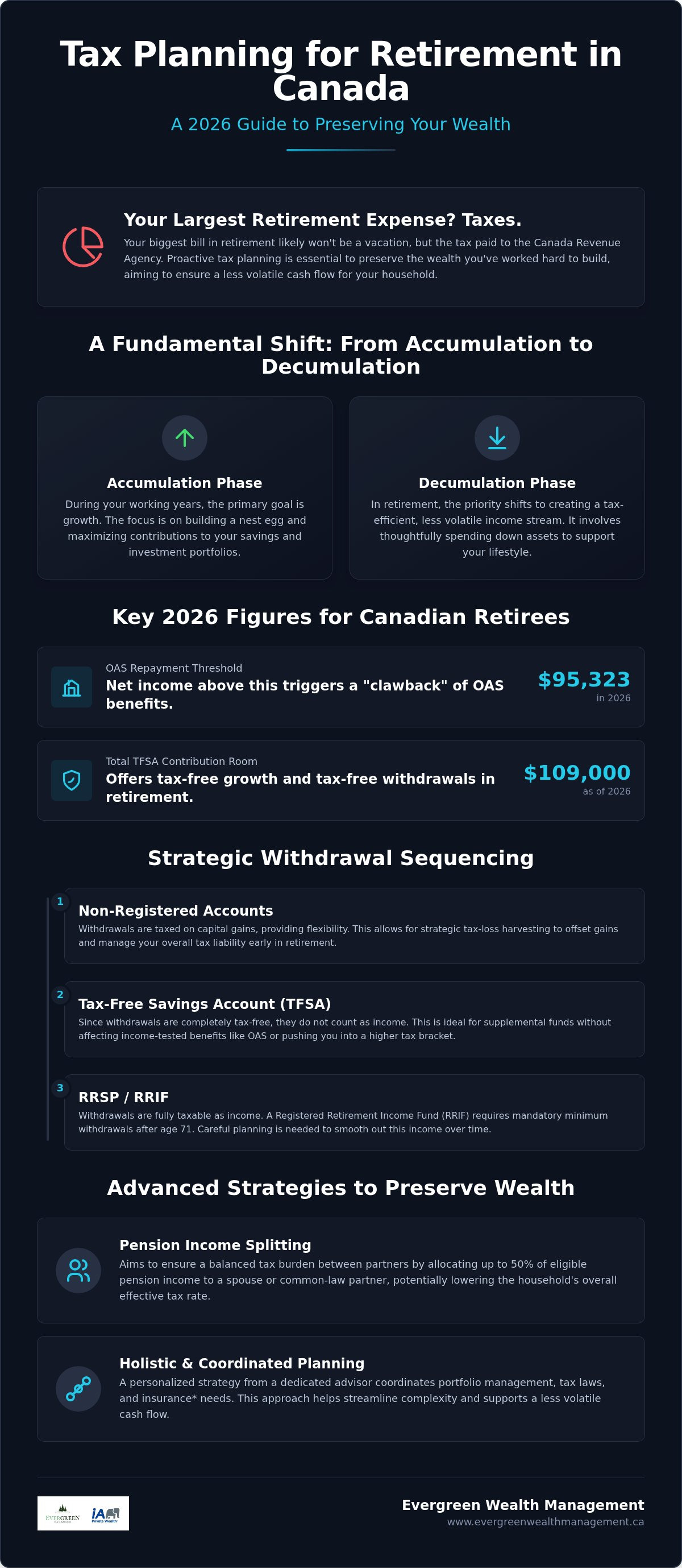
Your largest expense in retirement won’t likely be the dream cottage or travel abroad, but rather the tax bill you pay to the Canada Revenue Agency. It’s common to feel a sense of unease when considering how OAS clawbacks or high tax brackets might erode your hard-earned savings. You’ve worked hard to cultivate your wealth, and you deserve a strategy that respects that effort. Effective tax planning for retirement in Canada is about more than just checking boxes; it’s about orchestrating a rhythmic flow of income that respects your legacy.

This 2026 guide will show you how to refine your retirement income strategy and preserve more of your wealth through proactive Canadian tax planning. At Evergreen Wealth Management, iA Private Wealth, our dedicated advisors focus on creating a less volatile cash flow for your household. We’ll explore the 2026 tax thresholds, such as the OAS repayment threshold of $95,323 in 2026, and provide a clear framework for income splitting. Our practice favours a methodical approach to coordinate your withdrawals, which aims to ensure you keep more of what you’ve earned while considering your needs for portfolio management and insurance*.

Key Takeaways

  • Learn how a systematic approach to tax planning for retirement in Canada helps minimize liabilities while supporting a less volatile cash flow during your decumulation years.
  • Understand how you’ll maximize your 2026 registered account limits, including the total TFSA room of $109,000 as of 2026, and manage the mandatory transition to a RRIF.
  • Learn the sequence of asset withdrawals and the use of pension income splitting, which aims to ensure a balanced tax burden between partners to preserve more of your household wealth.
  • Navigate the complexities of the 2026 capital gains inclusion rate by using tax-loss harvesting to offset gains in your non-registered portfolio.
  • Realize the value of a personalized strategy from a dedicated advisor at Evergreen Wealth Management, where we help streamline complex tax laws and coordinate your portfolio management and insurance* at our practice.

Understanding Tax Planning for Retirement in Canada to Support Long-Term Cash Flow

Tax planning for retirement in Canada is the intentional, systematic arrangement of your financial affairs to minimize tax liability as you enter the decumulation phase of life. It’s a deliberate process that shifts the focus from building a nest egg to thoughtfully spending it. For many Canadian families, this planning is the cornerstone of wealth preservation. It seeks to balance your income needs today with the longevity of your portfolio for the decades ahead. By analyzing all income streams, from government benefits like the Canada Pension Plan (CPP) to private pensions, personal investments, and insurance* solutions, a dedicated advisor can help you visualize a clear path forward.

The Shift from Accumulation to Decumulation

Moving from a saving mindset to a spending strategy requires a fundamental change in perspective. During your working years, the goal was growth and accumulation. In retirement, the priority shifts toward creating a less volatile income stream that supports your chosen lifestyle without unnecessary tax friction. This transition involves a different set of rules and requires dedicated oversight to avoid common pitfalls. At our practice, we focus on simplifying this complexity. Your advisor at Evergreen Wealth Management works to coordinate these moving parts, helping you move from the anxiety of the unknown to the clarity of a well-considered plan. This rhythmic coordination of withdrawals allows a household to maintain its standard of living while minimizing the share given to the CRA.

Why Tax Efficiency is the Key to Longevity

Tax efficiency is often the silent engine behind a successful retirement. When taxes aren’t managed proactively, they can prematurely deplete even the most robust portfolios. It’s vital to distinguish between your marginal tax rate, which is the tax paid on your next dollar of income, and your effective tax rate, which is the actual percentage of your total income that goes to the government. Reducing the latter is a primary goal of tax planning for retirement in Canada. By focusing on the net amount that lands in your bank account rather than just the gross returns, you can better preserve your capital for future years. This refined approach to retirement portfolio management in Canada aims to ensure that your wealth endures as long as you do. Without this foresight, a retiree might find themselves in a higher tax bracket than necessary, simply because they withdrew from the wrong account at the wrong time.

Maximizing Registered Accounts and Government Benefits with 2026 Tax Strategies

The year 2026 represents a significant milestone for many Canadian retirees looking to refine their income strategies. Effective tax planning for retirement in Canada involves a delicate dance between your personal savings and the benefits provided by the state. By understanding the evolving rules surrounding registered accounts, you can create a structure that supports your lifestyle while minimizing the tax burden. This coordination isn’t just about the numbers; it’s about the peace of mind that comes from knowing your cash flow, portfolio management, and insurance* needs are optimized for the long term. At Evergreen Wealth Management, we focus on providing the clarity needed to make these decisions with confidence.

Optimizing RRSP and TFSA Contributions and Withdrawals

Your Tax-Free Savings Account (TFSA) and Registered Retirement Savings Plan (RRSP) are two of the most powerful tools in your financial toolkit. By 2026, the total TFSA room of $109,000 as of 2026 offers a substantial opportunity for tax-free growth and withdrawals. Unlike other accounts, the TFSA doesn’t trigger taxes when you take money out, making it a perfect source for supplemental income when you need to stay in a lower tax bracket. Managing your RRSP requires a different approach. You’ve benefited from tax deductions during your high-income years, but you must eventually convert this account into a Registered Retirement Income Fund (RRIF) by the end of the year you turn 71. A dedicated advisor can help you plan these withdrawals to avoid “tax spikes” that often occur when mandatory RRIF minimums begin. This methodical approach aims to ensure your retirement income remains less volatile across different stages of your life.

Government Benefit Timing: CPP and OAS

Timing your Canada Pension Plan (CPP) and Old Age Security (OAS) payments is a critical component of tax planning for retirement in Canada. While many retirees choose to start these benefits as soon as they’re eligible, deferring them until age 70 can result in significantly higher monthly payments. It’s important to remember that these payments are fully taxable as ordinary income. One of the most common anxieties for high-net-worth retirees is the OAS clawback. In 2026, the OAS repayment threshold is $95,323 in 2026. If your net income exceeds this figure, you’ll be required to pay back a portion of your benefit. You can find more specific details in the CRA Guide on Government Benefits. By coordinating your RRIF withdrawals with the start of your CPP and OAS, you can better manage your total taxable income. If you’d like to explore how these dates affect your personal plan, you’re welcome to speak with an advisor at our practice to review your cash flow projections.

Strategic Income Splitting and Withdrawal Sequencing for Retirees in Canada

Coordinating how and when you draw from your various accounts is a vital component of tax planning for retirement in Canada. It isn’t just about the total value of your portfolio; it’s about the net income that actually reaches your bank account. When a household manages multiple income streams, the goal is to balance the tax load so that neither spouse is pushed into an unnecessarily high tax bracket. This rhythmic approach to cash flow helps create a less volatile financial environment for your family. At Evergreen Wealth Management, our advisors focus on building a sequence that respects your long-term goals while minimizing the annual friction caused by the CRA.

To achieve this, we often follow a structured methodology to refine your withdrawal plan:

  • Step 1: Determine the most tax-efficient order to draw down assets, typically starting with taxable accounts, then moving to RRSP/RRIF assets, and finally utilizing the TFSA, but the optimal withdrawal sequence is individualized based on the circumstance.
  • Step 2: Utilize pension income splitting to balance the tax burden between spouses, which can significantly lower the overall household tax bill.
  • Step 3: Consider a spousal RRSP to even out future retirement income levels, particularly if one partner has traditionally been the higher earner.
  • Step 4: Monitor the 2026 tax brackets to ensure your total withdrawals don’t trigger a higher marginal rate than anticipated.

The Art of Pension Income Splitting

Pension income splitting is a powerful tool that allows you to allocate up to 50% of your eligible pension income to your spouse or common-law partner. This strategy is particularly effective when there’s a significant disparity in income between partners. For those over the age of 65, RRIF income qualifies for this treatment, allowing you to effectively shift taxable income to the person in the lower bracket. This practice aims to ensure a more equitable distribution of wealth within the home and reduces the total amount of tax paid to the government. It’s a cornerstone of wealth preservation that our advisors use to support the longevity of your savings.

Refining the Withdrawal Sequence

The order in which you access your funds can have a profound impact on how long your money lasts. Generally, taking money from non-registered, taxable accounts first allows your RRSP and RRIF assets to continue growing on a tax-deferred basis for as long as possible. However, there are exceptions. If you have a year with unusually low income, it might make sense to draw from your RRSP early to “fill up” a lower tax bracket. You can find a more detailed breakdown in our Retirement Income Streams in Canada: A Strategic Cash Flow Checklist. By being intentional with this sequence, you can preserve the tax-sheltered nature of your accounts while maintaining a steady, less volatile lifestyle. This level of foresight is what defines a personalized wealth management strategy at Evergreen Wealth Management.

Advanced Strategies to Preserve Wealth and Manage Capital Gains in Your Practice

Preserving your legacy requires a different level of precision as tax laws evolve. While earlier sections focused on your day-to-day cash flow, advanced tax planning for retirement in Canada looks at the broader landscape of your non-registered assets and eventual estate. Our practice works with families to identify “extra assets” that may not be required for retirement lifestyle, allowing us to implement strategies that support your heirs rather than the tax office. By coordinating portfolio management with intentional timing, we aim to ensure your wealth remains as intact as possible through the years.

Managing the 2026 Capital Gains Landscape

We focus on tax-loss harvesting within your non-registered accounts to offset capital gains. By realizing losses strategically, your advisor can help you stay below significant tax triggers, which results in a less volatile tax bill at year-end. This methodical approach to organizing your portfolio helps you keep a larger portion of your growth while navigating the shifting rules of the Canadian tax system.

Preserving the Estate for the Next Generation

Preserving the value of your estate often comes down to managing the final tax bill that arrives upon the passing of a second spouse. This is often the largest single tax event a family will face. This is where insurance* may play an important role in a well-considered plan. It provides the necessary liquidity to settle estate obligations without forcing the sale of cherished family assets or liquidating investments at an inopportune time. You can explore these concepts further in our Professional Guide to Insurance* for Retirement in Canada (2026).

At Evergreen Wealth Management, we believe every dollar preserved is a testament to your hard work and foresight. We don’t just look at the current year; we look at how your assets will transition to the next generation. If you’re concerned about how these 2026 changes affect your legacy or want to refine your strategy for capital gains, reach out to our practice to start a conversation about your wealth preservation goals. We’re here to help you move from complexity to a clear, actionable methodology.

Retirement Tax Planning in Canada: 2026 Guide

Holistic Planning with Evergreen Wealth Management

At Evergreen Wealth Management, we believe that the most effective tax planning for retirement in Canada is built on a foundation of trust and clarity. While the technical rules of the CRA are complex, your experience of them shouldn’t be. Our office takes the burden of coordination off your shoulders, allowing you to focus on the moments that matter most. A dedicated advisor works to streamline these intricacies, transforming a source of anxiety into a structured, less volatile cash flow plan. We prioritize the human element of financial planning, recognizing that every figure on a balance sheet represents a goal, a dream, or a legacy you’ve worked decades to build.

A Personalized Approach to Wealth Preservation

Every retirement journey is as unique as a fingerprint. Your tax strategy should be a reflection of your specific legacy goals, not a generic template. At our practice, we prioritize a boutique mindset that values the human element over cold data. We coordinate with your other professional partners to support your overall vision, aiming to ensure that every aspect of your wealth management for retirees in Canada is in harmony. This focus on long-term stability helps create a less volatile financial future for you and your heirs. By looking at the big picture, including estate planning and insurance* solutions, we help you preserve what you’ve spent a lifetime creating.

Next Steps: Organizing Your 2026 Retirement Plan

The first step toward a more refined strategy is to review your current income streams for potential tax leaks. Small adjustments today can lead to significant wealth preservation over decades. You might find more inspiration in our guide on how to minimize tax in retirement in Canada: a 2026 strategic guide. When you’re ready to move from philosophy to execution, scheduling a consultation with an advisor at Evergreen Wealth Management is a natural next step. Our practice is dedicated to helping you realize your vision for a peaceful and organized retirement. Let’s work together to bring order to your financial landscape and support the lifestyle you’ve earned.

Cultivating a Legacy of Clarity and Order

The transition into retirement is a significant milestone that deserves a strategy as intentional as the years you spent building your wealth. By coordinating your withdrawal sequence and staying mindful of thresholds like the OAS repayment threshold of $95,323 in 2026, you can maintain a less volatile lifestyle. Proactive tax planning for retirement in Canada isn’t about complex jargon; it’s about the rhythmic management of your resources to preserve your legacy for the next generation. This approach aims to ensure that your cash flow remains steady even as the tax landscape evolves.

Our boutique wealth management practice is focused on providing the personal attention your situation requires. We prioritize integrated tax and cash flow planning to support your long-term wealth preservation. If you’re ready to move from uncertainty to a clear methodology, connect with a dedicated advisor at Evergreen Wealth Management to refine your retirement tax strategy. We’re here to help you move forward with confidence and peace of mind.

Frequently Asked Questions

What is the OAS repayment threshold for 2026 in Canada?

The OAS repayment threshold is $95,323 in 2026. If your net world income exceeds this amount, you’ll be required to repay 15 cents for every dollar above the limit. This clawback is a common concern in tax planning for retirement Canada, but it can be managed through strategic withdrawal timing and income splitting. Our practice focuses on these nuances to help you keep more of your benefits.

How does pension income splitting work for Canadian retirees?

Pension income splitting allows you to allocate up to 50% of your eligible pension income to your spouse or common-law partner on your tax return. This strategy is highly effective for retirees over age 65 who receive RRIF or private pension income. By shifting income to a partner in a lower tax bracket, you can reduce the total household tax bill and create a less volatile cash flow. You can find more details in the CRA guide on pension splitting.

Should I withdraw from my TFSA or RRSP first in retirement?

Many retirees should consider withdrawing from non-registered taxable accounts first, followed by RRSP or RRIF assets, and finally their TFSA. This sequence allows your tax-sheltered accounts to benefit from compounding for a longer period. However, a dedicated advisor at our practice might suggest melting down an RRSP early if you’re in an unusually low tax bracket. This approach helps prevent a massive tax hit when mandatory RRIF withdrawals begin at age 72.

How can I minimize tax on my RRIF withdrawals in Canada?

You can minimize tax on RRIF withdrawals by utilizing pension income splitting with a spouse or by only withdrawing the mandatory minimum amount required by the CRA. Another method is to time larger withdrawals during years when your other income sources are lower. Integrating these choices into a broader strategy for tax planning for retirement Canada aims to ensure you preserve more of your capital for the decades ahead.

Can insurance* help with tax planning for my estate in Canada?

Yes, insurance* can be an effective tool for managing the significant tax liabilities that often arise during estate settlement. Life insurance policies can generally provide a tax-free death benefit that can be used to pay the final tax bill on your estate, such as capital gains on a family cottage. This liquidity can support your heirs and reduce the chances of a forced sale of family assets.

What is the maximum TFSA contribution room as of 2026?

The total TFSA room of $109,000 as of 2026 is available to individuals who have been eligible since the account’s inception in 2009. This figure includes the accumulated annual limits plus any withdrawals made in previous years. Maximizing this space is a cornerstone of a personalized wealth management strategy, as it provides a source of income that doesn’t trigger OAS clawbacks or increase your marginal tax rate.

How do I avoid a high tax bill on my final return in Canada?

Minimizing a high tax bill on your final return may involve a  combination of beneficiary designations, life insurance*, and charitable giving strategies. In Canada, you’re deemed to have sold all your assets at fair market value upon death, which can lead to a substantial tax event. A dedicated advisor at our practice can help you structure your estate planning to support your family and preserve your hard-earned legacy. For more resources, visit http://www.evergreenwealthmanagement.ca.

Article by

Rodney Anton

Rodney Anton is a Portfolio Manager, Senior Investment Advisor at Evergreen Wealth Management | iA Private Wealth, and an Insurance Advisor* at Evergreen Wealth Management Inc. He works with executives, professionals, and business owners to help coordinate investment strategy, tax planning, retirement income, and long-term wealth creation. Rodney focuses on building practical, personalized financial strategies that help clients preserve what they have built while identifying opportunities for growth.

Disclaimer

This information has been prepared by Rodney Anton who is a Portfolio Manager for iA Private Wealth Inc. and does not necessarily reflect the opinion of iA Private Wealth. The information contained in this article comes from sources we believe reliable, but we cannot guarantee its accuracy or reliability.

The comments and roles contained herein are a general discussion of certain issues intended as general information only and should not be relied upon as tax, legal or financial advice. Please obtain independent professional advice in the context of your particular circumstances. Only products and services offered through iA Private Wealth Inc. are covered by the Canadian Investor Protection Fund.

The opinions expressed are based on an analysis and interpretation dating from the date of
publication and are subject to change without notice. Furthermore, they do not constitute an
offer or solicitation to buy or sell any of the securities mentioned. The information contained
herein may not apply to all types of investors.

This content was fully or partially generated by artificial intelligence. The advisor reviewed the critical information independently.

iA Private Wealth Inc. is a member of the Canadian Investor Protection Fund and the Canadian
Investment Regulatory Organization. iA Private Wealth is a trademark and a business name
under which iA Private Wealth Inc. operates

*Insurance products and services are offered through Evergreen Wealth Management Inc., an
independent and separate company from iA Private Wealth Inc. Only products and services offered through iA Private Wealth Inc. are covered by the Canadian Investor Protection Fund