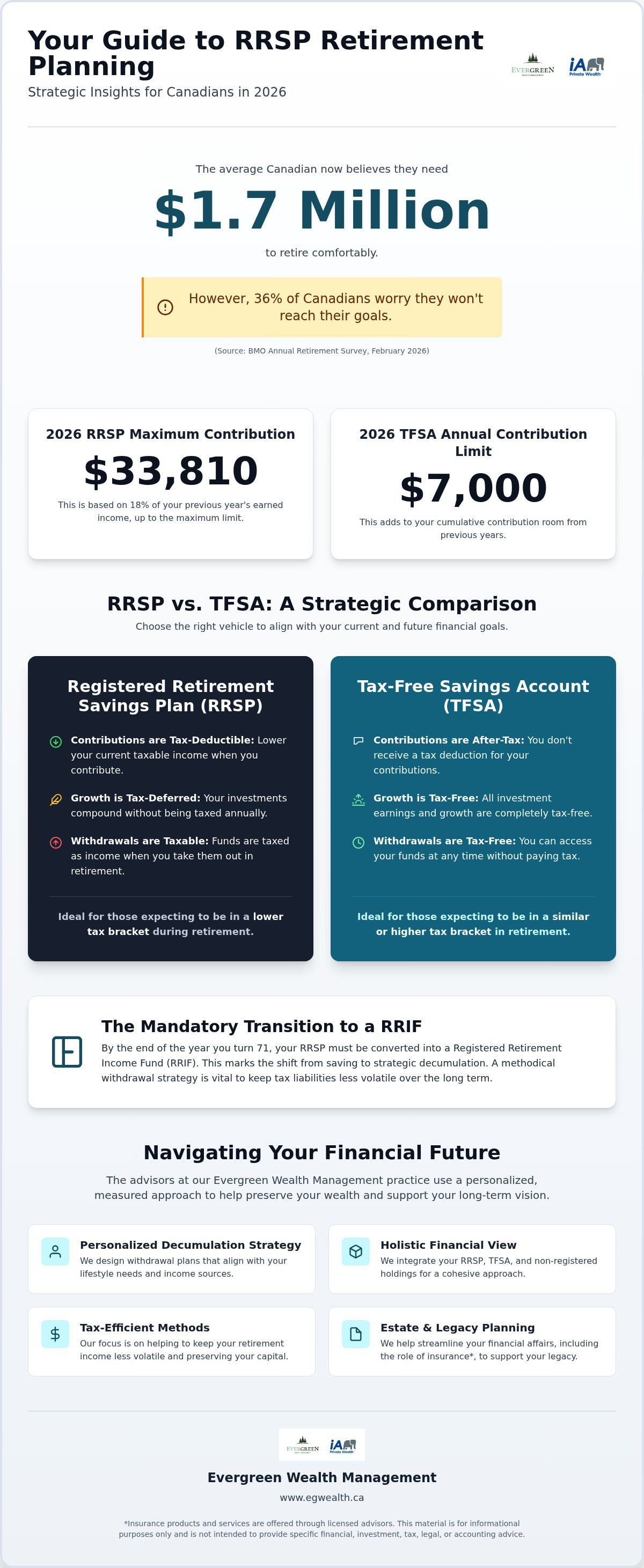
Did you know that the average Canadian now believes they need $1.7 million to retire comfortably? According to the BMO Annual Retirement Survey released in February 2026, this figure has risen steadily, yet 36% of Canadians worry they won’t reach their goals. It’s understandable to feel a sense of hesitation when faced with shifting rules and the potential for high tax hits during your withdrawal years. You’ve spent decades building your legacy, and you deserve a plan that helps you keep more of what you’ve earned through thoughtful RRSP retirement planning.

This guide provides the clarity you need to move forward with confidence. You’ll discover how to navigate the 2026 maximum RRSP contribution and how to balance this with the TFSA contribution limit in 2026. We’ll also preview how a dedicated advisor at Evergreen Wealth Management can help you design a decumulation strategy, including the role of insurance*, that aims to ensure your retirement income remains less volatile. By focusing on refined tax-efficient methods, our practice helps you preserve your capital and support your long-term vision at http://www.evergreenwealthmanagement.ca. We move at a measured pace to build your strategy step-by-step, leaving you in capable, organized hands.

Key Takeaways

  • Understand how the Registered Retirement Savings Plan functions as a sophisticated vehicle for tax-deferred growth to support your long-term financial goals.
  • Identify the 2026 contribution requirements, including the $33,810 maximum limit, to optimize your RRSP retirement planning for the year ahead.
  • Compare the immediate tax-deductibility of RRSPs with the tax-free benefits of TFSAs to choose the vehicle that aligns with your current and future income levels.
  • Learn the requirements for converting to a Registered Retirement Income Fund (RRIF) by age 71 and how strategic withdrawals can help keep your tax liabilities less volatile.
  • Discover how the advisors at our Evergreen Wealth Management practice use a personalized approach to help you preserve your wealth and streamline your estate planning, including the role of insurance*.

The Strategic Role of RRSP Retirement Planning in Canada

The Registered Retirement Savings Plan (RRSP) is a cornerstone of the Canadian financial system, designed to help you build a lasting legacy. It’s more than a simple account; it’s a tax-advantaged vehicle crafted to support your long-term financial goals through refined growth. At its heart, this structure is about creating a bridge between your peak earning years and a comfortable, intentional future. By prioritizing foresight today, you can create a path that feels steady and optimistic.

Think of the RRSP as a container that shields your assets from the immediate reach of the tax collector. This allows your contributions to grow without the drag of annual taxes on interest, dividends, or capital gains. This efficiency is vital because it leverages "tax arbitrage." You contribute when your income is high, receiving a deduction at your highest marginal rate, and withdraw later in life when your income is likely lower. For instance, with federal tax brackets reaching up to 33% on income over $258,482 in 2026, the value of a deduction for high earners is substantial.

Strategic RRSP retirement planning in Canada doesn’t happen in isolation. It requires a methodical integration with other assets, such as Tax-Free Savings Accounts (TFSAs) and non-registered holdings. This holistic view aims to ensure your wealth is managed with composure and clarity. By viewing your entire financial landscape as a single, evolving ecosystem, a focused advisor can help you determine which assets to tap into first, helping to keep your overall tax bill less volatile over the long term.

The Value of Tax-Deferred Compounding

Within an RRSP, every dollar earned remains in the account to work for you. Avoiding annual taxes on dividends and capital gains accelerates the growth of your portfolio over decades. This compounding effect creates a sense of movement, turning steady contributions into a substantial reservoir of wealth. Our retirement portfolio management approach prioritizes this efficiency, viewing it as a fundamental pillar for wealth preservation. By streamlining the growth process, our practice helps you focus on the horizon rather than the noise of seasonal market shifts.

RRSPs as a Tool for Tax-Efficient Cash Flow

Your immediate tax deduction is a powerful tool for optimization. You can reinvest these tax savings to further support the practice of wealth building, creating a cycle of growth that benefits from the passage of time. However, it’s vital to remember that taxes are deferred, not eliminated. This reality necessitates a professional withdrawal plan that accounts for future liabilities and potential clawbacks. A dedicated advisor at Evergreen Wealth Management can help you navigate this transition through RRSP retirement planning, focusing on drawing down retirement assets in a way that minimizes the impact on your lifestyle. This structured approach helps you maintain a clear understanding of your financial trajectory, even as your needs evolve and your reliance on other tools like insurance* increases.

Maximizing Contributions and Understanding Limits in 2026

Precision in RRSP retirement planning begins with a clear understanding of your boundaries. For the 2026 tax year, the maximum RRSP contribution limit is $33,810. This figure represents the ceiling for those whose 18% of earned income from the previous year exceeds this amount. While this number provides a general guide, your personal contribution room is unique to your financial history. You can find your specific deduction limit on your most recent CRA Notice of Assessment, which tracks your accumulated room over time and helps you plan with composure.

One of the most effective ways to use this tool is through the strategic application of carry-forward room. If you haven’t maximized your contributions in previous years, that unused space doesn’t disappear. It accumulates, allowing you to make larger contributions during years when your income is higher and the tax deduction is most valuable. This methodical approach to timing your contributions can significantly enhance your long-term wealth preservation. If you’re looking to refine your timing, you might connect with our office for a personalized review.

Remember that the deadline for making a contribution that can be applied to the 2026 tax year is typically the first 60 days of 2027. This window provides a final opportunity to assess your annual income and make a deliberate choice that supports your long-term trajectory. Our practice focuses on helping you navigate these deadlines without the pressure often found in high-volume banking environments.

The Impact of the Pension Adjustment

If you participate in a workplace pension plan, your individual RRSP room is adjusted to account for the value of those pension benefits. This is known as a Pension Adjustment (PA). It’s designed to create a level playing field between those with and without employer-sponsored plans. To calculate your net contribution room, the CRA subtracts your PA from 18% of your previous year’s earned income. For a comprehensive look at how these calculations affect your specific situation, the Canada Revenue Agency RRSP Guide provides official formulas and examples.

Spousal RRSPs: A Strategy for Income Splitting

A spousal RRSP is a thoughtful tool for couples with disparate income levels. By contributing to a plan in your partner’s name, you receive the immediate tax deduction while building a retirement fund for them. This strategy aims to ensure a less volatile tax burden in the future by balancing the eventual withdrawals between two people. It’s vital to be aware of the three-year attribution rule; if your spouse withdraws funds within three years of your contribution, the income may be taxed back to you. When managed with foresight, this approach supports a more balanced and intentional cash flow throughout your retirement years. This type of coordination is a staple of dedicated RRSP retirement planning within our practice.

RRSP vs. TFSA: Choosing the Right Vehicle for Your Goals

Selecting the appropriate account for your savings is a decision that balances your current needs with your future vision. The fundamental difference lies in the timing of the tax benefit. An RRSP offers a "tax-deductible now" advantage, reducing your taxable income in the year you contribute. In contrast, the Tax-Free Savings Account (TFSA) provides a "tax-free later" benefit, where your withdrawals, including all growth, are entirely exempt from taxes. For many Canadians, the cumulative opportunity is significant; the total TFSA room of $109,000 as of 2026 represents a substantial secondary pillar for wealth preservation.

A dedicated advisor often views these not as competitors, but as complementary tools. The choice depends largely on your marginal tax bracket today versus your expected bracket in the future. If you’re in your peak earning years, the immediate relief of an RRSP contribution is hard to overlook. However, if you anticipate being in a higher bracket later, the TFSA’s flexibility becomes invaluable. This RRSP contribution guide from RBC Wealth Management provides further perspective on how earned income and limits interact to shape these choices. By coordinating both vehicles, our practice helps you build a financial landscape that is methodical and intentional.

When to Prioritize the RRSP

Maximizing RRSP contributions is often the preferred path for high-income earners. The goal is to use the deduction to drop into a lower tax bracket, effectively creating an immediate return on your investment through tax savings. Beyond simple retirement savings, the RRSP supports specific life milestones through the Home Buyers’ Plan (HBP) or the Lifelong Learning Plan (LLP), allowing for tax-free withdrawals for a home purchase or education. The Evergreen Wealth Management methodology for account prioritization focuses on these strategic windows, helping you decide when to lead with an RRSP to support your broader objectives. This structured approach aims to ensure your capital is working in the most efficient environment possible.

When the TFSA Takes Precedence

The TFSA often takes center stage for individuals in lower tax brackets or those who value maximum liquidity. Because withdrawals don’t count as taxable income, they don’t impact income-tested government benefits. This is a critical factor for retirees, as TFSA income does not trigger the Old Age Security (OAS) recovery tax. With the OAS repayment threshold set at $95,323 in 2026, many find that using the TFSA to supplement their cash flow is a refined way to keep their retirement income less volatile. Our office prioritizes this type of foresight to help you preserve your lifestyle without unintended tax consequences. Whether you’re focusing on growth or estate preservation through insurance*, the TFSA offers a level of simplicity that complements a sophisticated RRSP retirement planning strategy.

The Transition: Converting RRSPs to RRIFs and Withdrawal Strategies

The shift from building your nest egg to thoughtfully spending it is one of the most significant transitions in your financial life. While the accumulation phase is about discipline, the decumulation phase requires a refined, methodical approach to preserve your capital. A critical milestone in RRSP retirement planning is the mandatory conversion of your account into a Registered Retirement Income Fund (RRIF) or an annuity. This transition must occur by December 31 of the year you turn 71. Once converted, you are required to take a minimum annual withdrawal, a figure that increases as you age and adds to your taxable income for the year.

Many Canadians wait until the mandatory deadline to begin withdrawals, but this can create a "tax bomb" if the account balance has grown substantially. A dedicated advisor often suggests smoothing out these liabilities by starting smaller, strategic withdrawals in your 60s. By drawing down assets earlier, you can potentially reduce the size of your RRIF in later years, which helps keep your lifetime tax burden less volatile. This foresight is a hallmark of the personalized service at Evergreen Wealth Management, where we prioritize your long-term peace of mind over short-term gains. If you are approaching this transition, you may wish to discuss your decumulation strategy with an advisor at our office.

Insurance* also plays a vital role in this phase of RRSP retirement planning. Because a RRIF is fully taxable upon the death of the final spouse, a large balance can be subject to a tax rate exceeding 50%. Utilizing insurance* can provide a tax-efficient way to cover this liability, aiming to ensure that your beneficiaries receive the full value of the legacy you intended to leave behind.

Managing the OAS Recovery Tax

Large, unplanned RRIF withdrawals can inadvertently push your income above the 2026 OAS repayment threshold of $95,323. When this happens, the government begins to claw back your Old Age Security benefits at a rate of 15% for every dollar over the limit. Our practice focuses on streamlining your cash flow to keep your net income below this threshold. By balancing RRIF income with tax-free TFSA withdrawals, we help you preserve your government benefits and maintain a steady financial trajectory.

Estate Planning and the Final Tax Return

Upon death, the CRA treats your RRIF as if you sold the entire balance on the final day of your life. This "deemed disposition" can result in a significant tax bill for your estate. However, naming a "successor annuitant" (typically a spouse) or a "designated beneficiary" can allow for a tax-deferred rollover of these assets. This intentional step is crucial for estate preservation. For a deeper look at how to support your heirs, please view our professional guide to insurance* for retirement. This structured approach helps you navigate complex transitions with the quiet authority of a well-considered plan.

Professional RRSP Retirement Planning Guide 2026

Professional Retirement Planning with Evergreen Wealth Management

Evergreen Wealth Management operates as a dedicated boutique practice, where we prioritize the human element over cold, institutional data. We understand that RRSP retirement planning in Canada involves more than just selecting investments; it’s about streamlining your financial landscape to reflect your personal values and long-term vision. Our advisors focus on an integrated approach, where portfolio management is harmonized with tax and cash flow planning. By moving at a methodical pace, we help you transition from the accumulation phase to a structured decumulation strategy with professional composure. This intentional process aims to ensure your wealth remains less volatile as you move through different life stages.

This integrated approach is essential because your retirement income often flows from multiple sources. Our office looks beyond the RRSP to see how your portfolio management interacts with your Tax-Free Savings Account and other non-registered assets. This holistic view helps us identify opportunities for tax optimization that might otherwise be missed. By streamlining these moving parts, we create a financial landscape that is easy to navigate and aligned with your broader legacy goals. We believe that every action should be part of a larger, well-considered strategy that values order and clarity.

A Bespoke Mindset for Wealth Preservation

Every family has a unique story, and every legacy requires a specific blueprint. Our office avoids the one-size-fits-all banking products often found at massive corporations, opting instead for a bespoke mindset that puts your needs first. We act as a steady mentor, providing a sense of calm when market volatility or changing regulations create uncertainty. This personalized attentiveness is a cornerstone of effective wealth management for retirees in Canada. Whether you’re navigating the complexities of estate preservation or the intricacies of insurance*, our goal is to support your vision through every season of life. For example, as we manage your cash flow, we remain mindful that the OAS repayment threshold is $95,323 in 2026, and we adjust your strategy to keep your income less volatile. We believe that a lasting relationship is built on reliability and a thorough understanding of your journey.

Next Steps: Organizing Your Financial Future

Taking the first step toward a more organized financial future starts with a deliberate review of your current strategy. We invite you to see how a dedicated advisor can help you refine your RRSP holdings and create clear projections for your future RRIF income. Proactive planning today aims to ensure that your path forward feels both comprehensive and easy to follow. By organizing your RRSP retirement planning with foresight, you can face the horizon with a sense of order and optimism. Our practice is here to help you simplify the complex, allowing you to focus on the people and passions that matter most. Reach out to our office to begin a conversation about your long-term journey at http://www.evergreenwealthmanagement.ca. Together, we can build a plan that reflects the refined future you’ve worked so hard to achieve.

Charting Your Path Toward a Refined Future

Effective RRSP retirement planning is about more than just hitting contribution limits; it’s about the intentional preservation of your wealth over time. We’ve explored how 2026 rules, like the $33,810 contribution cap and the OAS repayment threshold of $93,323 in 2026, require a methodical approach to tax-efficient cash flow. By balancing your RRSP with a total TFSA room of $109,000 as of 2026 and planning for the eventual RRIF transition, you can help keep your income less volatile during your most cherished years.

Evergreen Wealth Management provides the steady mentorship needed for these complex transitions. Our practice focuses on personalized wealth management strategies for Canadian families, with a dedicated focus on wealth preservation and tax-efficient cash flow. We move at a measured pace to support every part of your plan, from portfolio management to estate planning and insurance*, in a way that aims to ensure your legacy remains aligned with your vision. Discover how Evergreen Wealth Management can help organize your retirement journey. Take heart in knowing that with a clear strategy and a dedicated advisor by your side, your financial future can be as vibrant and enduring as you’ve envisioned.

Frequently Asked Questions

What is the maximum RRSP contribution limit for 2026?

The maximum RRSP contribution limit for 2026 is $33,810. This amount is capped at 18% of your earned income from the 2025 tax year, up to this specified maximum. You can verify your exact personal limit by reviewing your latest Notice of Assessment from the Canada Revenue Agency. Our practice helps you track these figures to support your long-term wealth preservation.

Can I contribute to my RRSP after I retire?

You can continue contributing to an RRSP as long as you have earned income and haven’t reached the end of the year in which you turn 71. If you’re over 71 but have a younger spouse, you may still contribute to a spousal RRSP using your own remaining room. This approach aims to ensure your tax strategy remains flexible even during your post-work years.

How does an RRSP withdrawal affect my taxes in Canada?

Any funds withdrawn from an RRSP are considered taxable income in the year they’re received and must be reported on your tax return. Financial institutions are required to withhold a portion of the withdrawal for taxes, ranging from 10% to 30% depending on the amount. A dedicated advisor at Evergreen Wealth Management can help you plan these withdrawals to keep your overall tax bill less volatile.

What happens to my RRSP if I move out of Canada?

You can generally keep your RRSP if you become a non-resident, though future contributions may be limited. Withdrawals made while living abroad are typically subject to a non-resident withholding tax, often 25%, unless a tax treaty between Canada and your new country specifies a lower rate. It’s vital to review these international implications to preserve your global assets effectively.

Is it better to invest in an RRSP or a TFSA in 2026?

The choice depends on your current income level and your expected tax bracket in retirement. In 2026, the annual TFSA limit is $7,000, while the RRSP maximum is $33,810. High-income earners often prioritize RRSP retirement planning to maximize immediate tax deductions. Conversely, those in lower brackets may prefer the TFSA to support tax-free growth and flexible future withdrawals at http://www.evergreenwealthmanagement.ca.

How do I avoid the OAS clawback with my RRSP withdrawals?

Strategically managing your income to stay below the 2026 OAS repayment threshold of $93,454 is the most effective way to avoid a clawback. You might consider taking smaller RRSP withdrawals before age 65 or using TFSA funds to supplement your cash flow, as TFSA withdrawals aren’t included in the clawback calculation. Our office focuses on these refined decumulation strategies to support your government benefits through RRSP retirement planning.

What is the deadline for RRSP contributions for the 2026 tax year?

The deadline to contribute to an RRSP for the 2026 tax year is March 1, 2027. Contributions made within the first 60 days of the new year can be deducted from your 2026 taxable income or carried forward to future years. This window allows you to finalize your annual tax strategy with composure, aiming to ensure you maximize your available deductions before the CRA deadline.

Can I hold US stocks in my RRSP without paying withholding tax?

Yes, RRSPs are specifically exempt from the 15% US withholding tax on dividends due to the tax treaty between Canada and the United States. This makes the RRSP an ideal vehicle for holding US-listed dividend-paying stocks within your portfolio management strategy. This exemption doesn’t apply to TFSAs, which is why a focused advisor often recommends placing US assets within your RRSP to preserve more of your investment returns.

Article by

Rodney Anton

Rodney Anton is a Portfolio Manager, Senior Investment Advisor at Evergreen Wealth Management | iA Private Wealth, and an Insurance Advisor* at Evergreen Wealth Management Inc. He works with executives, professionals, and business owners to help coordinate investment strategy, tax planning, retirement income, and long-term wealth creation. Rodney focuses on building practical, personalized financial strategies that help clients preserve what they have built while identifying opportunities for growth.

Disclaimer

This information has been prepared by Rodney Anton who is a Portfolio Manager for iA Private Wealth Inc. and does not necessarily reflect the opinion of iA Private Wealth. The information contained in this article comes from sources we believe reliable, but we cannot guarantee its accuracy or reliability.

The opinions expressed are based on an analysis and interpretation dating from the date of
publication and are subject to change without notice. Furthermore, they do not constitute an
offer or solicitation to buy or sell any of the securities mentioned. The information contained
herein may not apply to all types of investors.

This content was fully or partially generated by artificial intelligence. The advisor reviewed the critical information independently.

iA Private Wealth Inc. is a member of the Canadian Investor Protection Fund and the Canadian
Investment Regulatory Organization. iA Private Wealth is a trademark and a business name
under which iA Private Wealth Inc. operates

*Insurance products and services are offered through Evergreen Wealth Management Inc., an
independent and separate company from iA Private Wealth Inc. Only products and services offered through iA Private Wealth Inc. are covered by the Canadian Investor Protection Fund

Discover more from Evergreen Wealth Management

Subscribe now to keep reading and get access to the full archive.

Continue reading