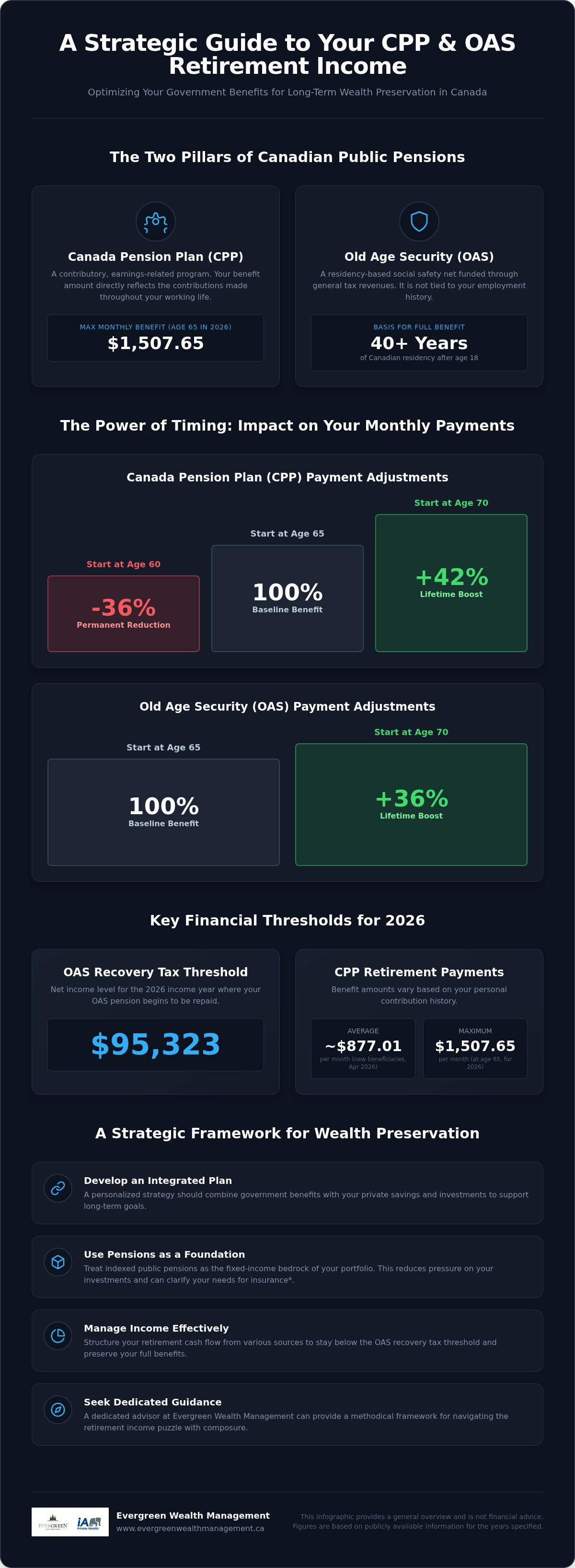
What if the most influential asset in your retirement portfolio isn’t your private savings, but the timing of your government benefits? For many Canadians, the choice of when to begin payments feels like a gamble against the clock; however, the data suggests a more intentional path. With the maximum monthly CPP benefit reaching $1,507.65 in 2026, the gap between an early start and a patient approach can result in a significantly different financial legacy. Developing a cohesive CPP and OAS retirement strategy is about more than just reaching age 65. It’s about refining your cash flow to support a long-term vision that remains vibrant for decades.

It’s understandable to feel anxious about the OAS recovery tax, particularly since the repayment threshold is $95,323 for the 2026 income year. You’ve spent a lifetime building your assets, and the prospect of a clawback can feel like an unnecessary hurdle. At Evergreen Wealth Management, iA Private Wealth, our advisors recognize that you want to preserve your capital while managing tax obligations effectively. This guide offers a structured framework to help you time your benefits and integrate them with your investments and insurance*. We’ll explore how a dedicated approach to wealth preservation can turn complexity into a clear, manageable plan.

Key Takeaways

  • Understand the mathematical advantages of deferral, which can increase your monthly CPP payments by 8.4% for every year you wait past age 65.
  • Develop a personalized CPP and OAS retirement strategy that integrates government benefits with your private savings to support long-term wealth preservation.
  • Learn to manage your income effectively to stay below the OAS repayment threshold of $95,323 in 2026 and preserve your social safety net.
  • Explore how to treat government pensions as fixed-income components within your portfolio to refine your asset allocation and insurance* requirements.
  • Discover how a dedicated advisor at Evergreen Wealth Management can provide a methodical framework for navigating the retirement income puzzle with composure.

The Foundations of a Strategic CPP and OAS Retirement Strategy

The foundation of a thoughtful retirement plan rests upon two distinct pillars of public support. The Canada Pension Plan (CPP) operates as a contributory, earnings-related program. Your benefits directly reflect the contributions made throughout your working life, creating a personal link between your career and your retirement income. In contrast, Old Age Security (OAS) serves as a residency-based social safety net, funded through general tax revenues rather than individual contributions. While these programs are often viewed as simple monthly cheques, they are actually sophisticated financial instruments. Integrating them into a broader CPP and OAS retirement strategy allows you to prioritize wealth preservation and manage cash flow with greater intentionality. A methodical approach helps you realize a plan where every dollar works in harmony with your private savings.

The Role of Public Pensions in Your Financial Practice

At Evergreen Wealth Management, our advisors view government income as more than just a supplement. These benefits function as the bedrock of your financial practice, providing a predictable stream of income that is indexed to inflation. This indexing is vital; it helps preserve your purchasing power against the rising costs of living. When your basic expenses are supported by reliable public pensions, the pressure on your private investment portfolio decreases. A dedicated advisor focuses on these payments as tax-efficiency tools, helping you realize a more streamlined distribution of your total wealth. This shift allows for a more patient approach to portfolio management, where your assets can continue to grow without the constant need for aggressive withdrawals, while also simplifying your needs for life insurance*.

Eligibility and Residency Requirements for 2026

To qualify for the full OAS benefit in 2026, you generally must have lived in Canada for at least 40 years after age 18. If you have at least 10 years of residency, you may still receive a partial payment. Your CPP entitlement is different; it’s determined by how much and how long you contributed to the plan. In 2026, the maximum monthly retirement benefit at age 65 is $1,507.65. Most Canadians receive closer to the average, which was approximately $877.01 for new beneficiaries as of April 2026. Both programs allow for payments to begin at age 65, yet the flexibility to start earlier or later creates a significant opportunity for optimization. Understanding these baseline figures is the first step toward creating a structured plan that supports your long-term vision and preserves your lifestyle for years to come.

Calculating the Impact of Timing: When to Start Your Benefits

Deciding when to activate your benefits is a pivotal moment in your CPP and OAS retirement strategy. While the option to begin CPP as early as age 60 exists, it comes with a permanent reduction of 0.6% for every month you precede your 65th birthday. Conversely, patience is rewarded. Delaying your start date can significantly enhance your monthly cash flow through the following adjustments:

  • Early CPP: A 36% total reduction if started at age 60.
  • Delayed CPP: An 8.4% annual increase, reaching a 42% total boost at age 70.
  • Delayed OAS: A 7.2% annual increase, reaching a 36% total boost at age 70.

OAS timing follows a similar logic. Delaying your OAS payments past age 65 provides a 0.6% monthly increase up to age 70. This 36% total increase is a significant component of wealth preservation. In the context of Canadian public pensions, earlier is not always better. By waiting, you effectively trade smaller, immediate payments for a larger, inflation-indexed stream of income that continues for life. This structured approach helps preserve your capital by allowing your private investments more time to grow undisturbed. It also reduces the rate at which you might need to draw down your RRSP or RRIF assets in the early years of retirement.

The 2026 Figures: Maximum Payments and Adjustments

In 2026, the maximum monthly CPP benefit at age 65 is $1,507.65. For Old Age Security, the maximum monthly benefit for individuals aged 65 to 74 is $751.97 for the July to September 2026 quarter. You should also recognize the structural shift for older seniors; recipients aged 75 and older in 2026 receive an automatic 10% increase to their OAS pension, which brings the maximum monthly payment to $827.17 for the same period. These figures highlight the evolving nature of the retirement landscape and the need for a focused plan that accounts for long-term growth.

Break-Even Analysis for Professional Retirees

A break-even analysis is a methodical way to determine your personal "sweet spot" for starting benefits. This calculation considers your health status and family history to estimate how many years you’d need to receive the higher, delayed payments to surpass the total cumulative value of starting earlier. Because these payments are adjusted annually for inflation, the value of a higher starting point compounds over time. At Evergreen Wealth Management, our advisors help you model these scenarios to reduce anxiety and provide clarity. We look at your entire financial landscape, including your tax profile and estate goals, to see how timing affects your long-term success. If you’re ready to see how these numbers apply to your specific situation, you can reach out to our office to begin a conversation.

While increasing your monthly benefits through deferral is a primary goal, high-income earners must remain mindful of the OAS Recovery Tax. This mechanism, often called the clawback, reduces your pension if your net world income exceeds a specific limit. For the 2026 tax year, the OAS repayment threshold is $95,323. If your income passes this mark, you’ll be required to repay 15% of the excess, up to the full amount of your pension received. It’s a common source of frustration for retirees who’ve worked hard to build their wealth, yet it doesn’t have to be an inevitable hurdle. A sophisticated CPP and OAS retirement strategy accounts for these limits by smoothing your income across various sources to preserve as much of your benefit as possible.

Strategies to Minimize the OAS Recovery Tax

One of the most effective ways to stay below the threshold is through income splitting strategies for Canadian retirees. By allocating eligible pension income to a lower-earning spouse, you can lower your individual taxable income and keep your total household cash flow steady. Additionally, TFSA withdrawals play a vital role in this practice. Since TFSA distributions aren’t considered taxable income, they don’t count toward the $95,323 limit in 2026. For business owners, using corporate structures to manage the timing of dividends or salary can also help you stay within a specific tax bracket. These methods aren’t about avoiding obligations; they’re about using the available framework to support your financial health and long-term vision.

Tax and Cash Flow Planning for High-Net-Worth Households

Managing a high-net-worth portfolio requires a delicate balance between mandatory RRIF withdrawals and government pension start dates. If you’re forced to take large RRIF payments while also receiving maxed-out CPP and OAS, you might find yourself pushed well into the clawback zone. A dedicated advisor at Evergreen Wealth Management prioritizes tax-efficient decumulation to prevent this. We look at your total cash flow, including your insurance* needs and estate goals, to determine the most logical sequence for drawing down assets. Proactive income smoothing ensures that you don’t face unnecessary tax liabilities in your later years. By organizing your withdrawals with foresight, our office helps you maintain the lifestyle you’ve envisioned while keeping more of your hard-earned benefits.

Strategic Portfolio Management and Pension Integration

A robust CPP and OAS retirement strategy isn’t just about timing government cheques; it’s about how those cheques redefine your investment approach. Because CPP and OAS are inflation-indexed and last for life, they function effectively as a substantial, government-backed fixed income component. This floor provides the composure needed to adjust your equity-to-bond ratio elsewhere in your portfolio. If your basic needs are supported by these pensions, you may have a higher capacity for equity growth in your private accounts. This synergy is a core part of portfolio management in Canada. It allows you to maintain liquidity for lifestyle goals while your government payments provide a steady foundation for your cash flow.

Coordinating RRSP and RRIF Withdrawals

Deciding whether to deplete registered assets before activating your CPP is a significant tactical choice. If you draw from your RRSP or RRIF in your early 60s while delaying CPP until age 70, you might lower your total lifetime tax bill. This is because you’re withdrawing from taxable accounts when your total income is lower. Once you reach age 71 and mandatory RRIF minimums begin, combining those with a maximum CPP payment can lead to a heavy tax hit. Our advisors help you realize the value of deferred growth in your CPP while managing the immediate tax consequences of registered withdrawals. It’s a methodical way to support your wealth preservation goals without triggering unnecessary liabilities.

Wealth Preservation and Legacy Considerations

Your pension income can also play a vital role in your estate plan. For instance, the reliable cash flow from OAS and CPP can be used to fund insurance* premiums. This strategy helps you preserve your capital for your heirs rather than spending it on estate taxes. Additionally, these pensions support your ability to cover potential long-term care costs without liquidating your core portfolio. When choosing wealth management for retirees in Canada, it’s essential to account for survivor benefits. Supporting your spouse after your passing is a hallmark of a thoughtful legacy plan. If you want to see how your portfolio can be optimized alongside your government benefits, book a consultation with our office today.

Optimizing Your CPP and OAS Strategy: 2026 Guide

How Evergreen Wealth Management Supports Your Retirement Vision

Retirement isn’t merely a financial destination; it’s a significant life transition that deserves a methodical and structured approach. For many, the "retirement income puzzle" creates a sense of unease, as the variables of tax, timing, and longevity converge. However, it’s possible to move from anxiety to a sense of order with the right guidance. At Evergreen Wealth Management, our advisors prioritize a steady, long-term vision that focuses on clarity and foresight. Developing a comprehensive CPP and OAS retirement strategy requires a partner who understands the human element behind the numbers, recognizing that your wealth represents a lifetime of hard work and specific aspirations.

Our office provides clarity through personalized cash flow modelling, allowing you to see how every piece of your financial life fits together. This isn’t about chasing short-term gains or reacting to market noise. It’s about a commitment to steady growth and wealth preservation that spans decades. By creating a structured plan, we help you realize a future that feels organized and intentional, reducing the stress of navigating complex government programs alone. This orderly approach allows you to focus on the people and experiences that matter most during your retirement years.

An Individualized Mindset for Pre and Post Retirement Planning

Every individual comes to our practice with a unique history and a distinct set of goals. Our advisors focus on analyzing your specific tax situation to optimize pension timing, whether that means delaying benefits to age 70 or starting earlier to preserve other private assets. We also look beyond your own retirement to the legacy you wish to leave. Estate planning is a core component of our work, where we help you preserve wealth across generations. This often involves the strategic use of insurance* to support your heirs and manage final tax liabilities effectively. As a boutique practice, we pride ourselves on being attentive and reliable, prioritizing your peace of mind above all else.

Your Next Steps Toward a Simplified Retirement

The journey toward a simplified retirement begins with a clear understanding of your current entitlements and how they interact with your savings. Gathering your Service Canada statements for a structured review is an excellent first step in this process. While many people wait until they’re on the cusp of retirement, there’s immense value in starting the conversation in your 50s. This foresight allows for more flexibility in your tax and cash flow planning, helping you stay below the OAS repayment threshold of $95,323 in 2026. If you’re ready to move forward with a plan that supports your long-term vision, connect with an advisor at Evergreen Wealth Management today.

Realizing Your Vision Through Intentional Planning

A refined CPP and OAS retirement strategy is more than a set of dates on a calendar. It’s a commitment to a life of composure and clarity. By understanding that the OAS repayment threshold is $95,323 in 2026, you can make proactive choices that preserve your benefits and support your long-term wealth. Integrating these public pensions with your private portfolio allows you to navigate the future with a sense of order, knowing every component of your plan is working in harmony.

At Evergreen Wealth Management, our advisors are dedicated to helping you solve the complex retirement income puzzle. Our practice is focused on tax-efficient wealth preservation and providing personalized estate and insurance* solutions tailored to the Canadian landscape. You don’t have to navigate these transitions alone. With a methodical approach and a steady partner, you can turn uncertainty into a structured path forward. Request a consultation with Evergreen Wealth Management to begin your journey toward a simplified, vibrant retirement. You’ve worked hard for your future; it’s time to see it realized with grace and foresight.

Frequently Asked Questions

What is the best age to start CPP and OAS for a high-net-worth individual?

For many high-net-worth individuals, delaying benefits until age 70 is often the most effective path within a CPP and OAS retirement strategy. This choice results in a 42% increase for CPP and a 36% increase for OAS compared to starting at age 65. By using private capital or corporate dividends to support your lifestyle in your early 60s, you allow these inflation-indexed government benefits to grow. This approach prioritizes long-term wealth preservation and provides a higher income floor later in life.

How does the OAS recovery tax work in 2026?

The OAS recovery tax, or clawback, applies when your net world income exceeds the OAS repayment threshold of $95,323 in 2026. For every dollar earned above this limit, you must repay 15 cents of your OAS pension. This calculation is based on your individual tax return rather than household income. Advisors at Evergreen Wealth Management focus on income smoothing and tax-efficient withdrawal sequences to help you stay below this threshold and preserve your benefits.

Can I split my CPP income with my spouse to save on taxes?

You can share your CPP retirement pension with your spouse or common-law partner to lower your overall household tax bill. This process, known as pension sharing, is different from the pension income splitting used for RRIF withdrawals. Both partners must be at least 60 years old and receive their pensions to qualify. It’s a methodical way to support a lower total tax liability by moving income from a higher-earning spouse to one in a lower bracket.

What happens to my CPP and OAS if I continue to work after 65?

If you continue to work after age 65 while receiving CPP, you can choose to keep contributing to the plan to earn the Post-Retirement Benefit (PRB). This benefit increases your pension the following year. Contributions become optional after age 65 and stop entirely at age 70. Your OAS payments aren’t reduced by employment income unless your total annual earnings push you past the OAS repayment threshold of $95,323 in 2026.

Are CPP and OAS payments taxable in Canada?

Yes, both CPP and OAS payments are considered taxable income and must be reported on your annual tax return. Unlike some private investment distributions, the government doesn’t automatically withhold enough tax to cover your full liability. You can request a voluntary tax deduction at the source to avoid a large bill in April. An advisor at our office can help you realize how these payments affect your total tax landscape and your needs for insurance*.

What are the maximum CPP and OAS amounts for 2026?

The maximum monthly CPP benefit at age 65 is $1,507.65 in 2026. For Old Age Security, the maximum monthly amount for those aged 65 to 74 is $751.97 for the July to September 2026 quarter. Seniors aged 75 and older receive a 10% increase, bringing their maximum monthly payment to $827.17. These figures are adjusted quarterly or annually to support your purchasing power against inflation.

How does delaying CPP until age 70 affect my survivor benefits?

Delaying your CPP increases your own retirement pension, which can result in a higher survivor benefit for your spouse. The survivor pension is calculated as a percentage of the deceased contributor’s pension. However, there’s a maximum limit on the total amount a survivor can receive if they also have their own CPP pension. Our practice looks at these combined benefit rules to support a plan that preserves cash flow for both partners regardless of the timing.

Is it possible to stop or delay my OAS payments once they have started?

You can cancel your OAS pension up to six months after you begin receiving it, provided you submit a written request and repay the benefits already received. This option is sometimes used by retirees who realize their income will trigger a significant clawback. After this six-month window, you cannot stop the payments. A dedicated advisor at Evergreen Wealth Management can help you model these scenarios before you apply to support a more intentional start date.

Article by

Rodney Anton

Rodney Anton is a Portfolio Manager, Senior Investment Advisor at Evergreen Wealth Management | iA Private Wealth, and an Insurance Advisor* at Evergreen Wealth Management Inc. He works with executives, professionals, and business owners to help coordinate investment strategy, tax planning, retirement income, and long-term wealth creation. Rodney focuses on building practical, personalized financial strategies that help clients preserve what they have built while identifying opportunities for growth.

Disclaimer

This information has been prepared by Rodney Anton who is a Portfolio Manager for iA Private Wealth Inc. and does not necessarily reflect the opinion of iA Private Wealth. The information contained in this article comes from sources we believe reliable, but we cannot guarantee its accuracy or reliability.

The opinions expressed are based on an analysis and interpretation dating from the date of
publication and are subject to change without notice. Furthermore, they do not constitute an
offer or solicitation to buy or sell any of the securities mentioned. The information contained
herein may not apply to all types of investors.

This content was fully or partially generated by artificial intelligence. The advisor reviewed the critical information independently.

iA Private Wealth Inc. is a member of the Canadian Investor Protection Fund and the Canadian
Investment Regulatory Organization. iA Private Wealth is a trademark and a business name
under which iA Private Wealth Inc. operates

*Insurance products and services are offered through Evergreen Wealth Management Inc., an
independent and separate company from iA Private Wealth Inc. Only products and services offered through iA Private Wealth Inc. are covered by the Canadian Investor Protection Fund

Discover more from Evergreen Wealth Management

Subscribe now to keep reading and get access to the full archive.

Continue reading