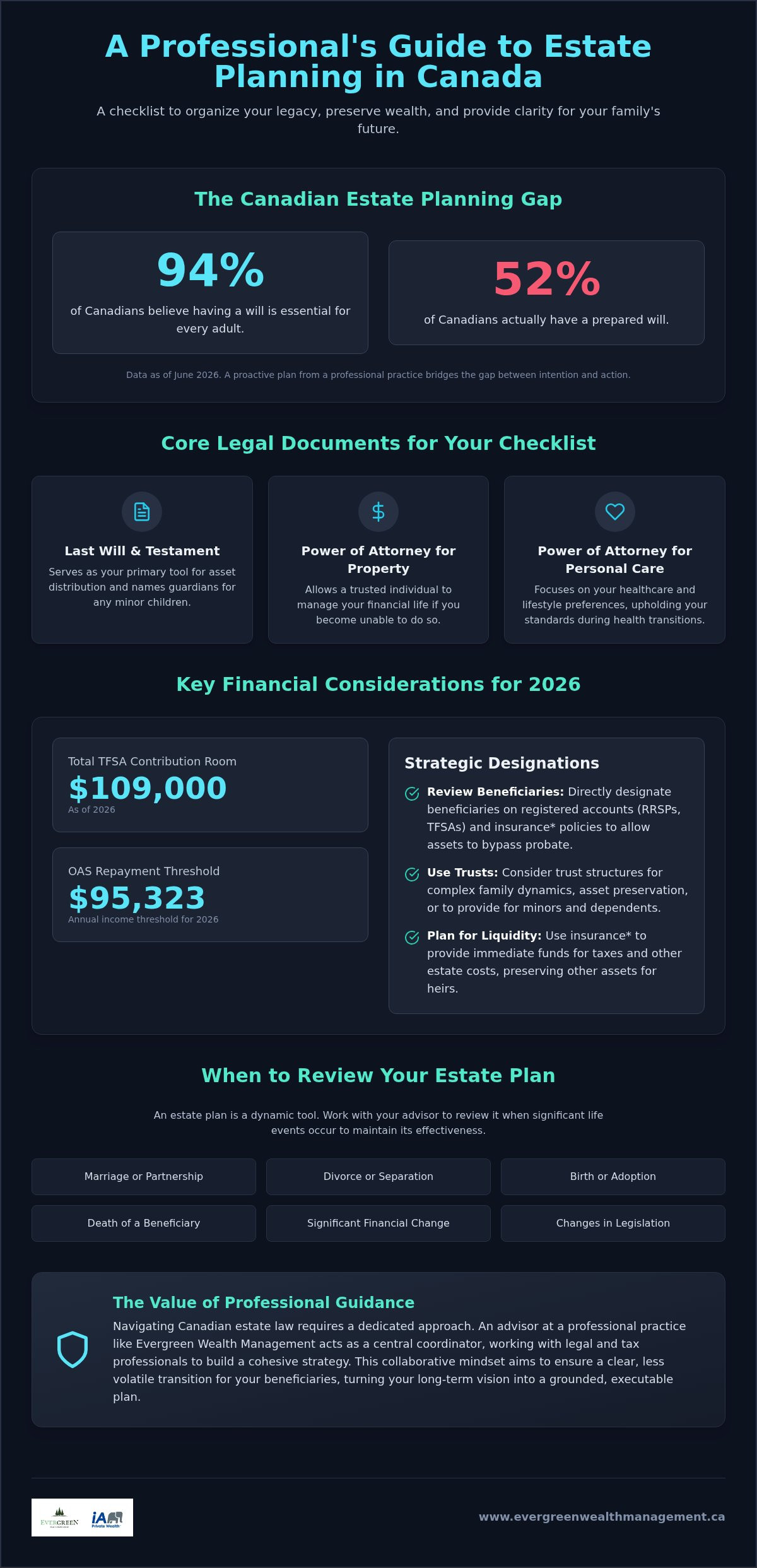
Did you know that while 94% of Canadians believe having a will is essential, only 52% actually have one as of June 2026? It’s a gap that often stems from the fear of leaving a heavy tax burden or confusion regarding beneficiary designations. You likely want your hard-earned assets to support your family rather than being lost to probate. At Evergreen Wealth Management, our advisors focus on helping you transition from uncertainty to clarity. This estate planning checklist in Canada provides a clear roadmap to organize your legacy.

In this guide, we’ll provide a structured path for wealth preservation, covering everything from the federal tax brackets for 2026 to maximizing your total TFSA room of $109,000 as of 2026. We’ll also look at how to select a dedicated executor and manage your insurance* needs to support your family’s future. By following this methodical approach, you’ll gain the confidence that your assets are organized for a smooth transition. To learn more about our process, you can explore our resources at http://www.evergreenwealthmanagement.ca.

Key Takeaways

  • Understand how a proactive, professional framework may help your legacy remain aligned with your family values and intentions.
  • Discover the essential legal documents for your estate planning checklist in Canada, including the critical roles of a Last Will and Testament and a Power of Attorney for Property.
  • Learn how to organize a comprehensive inventory of your registered accounts and understand how figures like the OAS repayment threshold of $95,323 in 2026 impact your wealth preservation strategy.
  • Explore how to use insurance* and trust structures to provide liquidity for estate taxes or to support the equal distribution of inheritances among your heirs.
  • Identify the specific “trigger events” that should prompt a review with your advisor at Evergreen Wealth Management to maintain long-term continuity and peace of mind.

The Role of Estate Planning in a Professional Wealth Strategy

Estate planning is often misunderstood as a final task to be completed in one’s later years. In reality, it’s a proactive framework for wealth preservation that begins long before retirement. For many families, an **estate planning checklist in Canada **serves as the foundation to begin building a legacy strategy that aligns with your values. By taking an intentional approach, you can create a clear path for your heirs, reducing the emotional and financial friction that often accompanies significant life transitions.

This process is a fundamental pillar of retirement portfolio management in Canada. It links your current financial growth with the long-term goal of supporting the next generation. Beyond the numbers, the true value of a well-considered plan lies in the peace of mind it provides. It minimizes the risk of future conflict among loved ones, allowing your family to focus on their connection rather than administrative burdens during a difficult time.

Why a Professional Practice Makes a Difference

Choosing a self-directed path for legacy planning can lead to oversights, especially when tax laws and provincial regulations shift. A dedicated advisor at Evergreen Wealth Management provides the oversight needed to navigate these complexities. Our office acts as a central hub, coordinating with legal and tax professionals to create a cohesive strategy. This is particularly important when managing thresholds like the OAS repayment threshold of $95,323 in 2026. This collaborative mindset is essential for complex Canadian family structures, where a personalized approach is required to address unique dynamics. By working with a professional practice, you benefit from a methodical rhythm that turns a broad vision into a grounded, executable plan.

Estate Planning Beyond the Will

While the Last Will and Testament is a vital component, it’s only one part of a broader wealth preservation strategy. A truly comprehensive plan includes "living" documents, such as Powers of Attorney, which address your needs if you’re unable to manage your affairs. Because Canadian inheritance law is governed primarily at the provincial level, your plan must be precise to avoid unnecessary delays. The goal is to create a transition that is less volatile for your beneficiaries. This involves reviewing beneficiary designations on registered accounts and considering how insurance* solutions can provide immediate liquidity. For instance, understanding how your assets fit within the total TFSA room of $109,000 as of 2026 is just as important as the document itself. At Evergreen Wealth Management, we believe that an estate planning checklist in Canada should be a dynamic tool that evolves alongside your life.

The architecture of a legacy is built upon specific legal instruments that translate your intentions into action. Without these documents, your wishes may be subject to provincial default rules, which often fail to account for the nuances of your family’s needs. A robust estate planning checklist in Canada starts with the Last Will and Testament. This document serves as your primary tool for asset distribution and, perhaps more importantly, allows you to name guardians for minor children. Following official government guidance on wills helps you understand that this isn’t just about property; it’s about providing a clear sense of direction for those you leave behind.

Equally vital are the documents that manage your affairs while you’re still living. A Power of Attorney for Property allows a trusted individual to manage your financial life if you become unable to do so, while a Power of Attorney for Personal Care focuses on your healthcare and lifestyle preferences. At Evergreen Wealth Management, we see these tools as essential for a less volatile transition of responsibilities when life takes an unexpected turn.

Selecting Your Estate Representative

Choosing an executor is one of the most personal decisions in the estate planning process. This individual or entity will manage your personal practice’s legacy, handling everything from tax filings to asset sales. You should look for specific professional qualities in a representative:

  • Impartiality: The ability to navigate family dynamics without bias.
  • Organization: Managing the complex timelines of probate and tax deadlines in 2026.
  • Availability: The time required to see a multi-year process through to completion.

While many choose a family member for their intimate knowledge of the family’s heart, a professional trust office offers a systematic approach that can reduce the burden on grieving heirs. Regardless of your choice, naming a backup executor is a dedicated step toward maintaining the continuity of your plan. If you’re feeling uncertain about this choice, you can reach out to an advisor at our office for a personalized consultation.

Powers of Attorney and Incapacity Planning

In Canada, it’s important to recognize the difference between a "General" and an "Enduring" Power of Attorney. A General Power of Attorney typically ends if you lose mental capacity, whereas an Enduring (or Continuing) Power of Attorney remains in effect, providing the support you need when you’re most vulnerable. These documents are designed to support your financial health in the case of unforeseen interruption. To make these documents effective, store them where they can be easily accessed by your representatives:

  • A fireproof safe within your home.
  • A digital vault or encrypted storage service.
  • With your legal professional or within our practice’s records.

By organizing these documents now, you’re not just filing paperwork; you’re creating a calm environment for your future self and your beneficiaries.

Financial Asset Inventory and Beneficiary Designations for 2026

Once the legal framework of your plan is established, the focus shifts to the wealth itself. A comprehensive estate planning checklist in Canada requires a meticulous inventory of everything you own, from registered accounts to digital footprints. This step isn’t just about listing assets; it’s about understanding how each one is titled and who is set to receive it. By organizing this data now, you provide your executor with a clear map, reducing the time and cost associated with settling your estate. It’s a methodical process that turns a complex web of accounts into a streamlined legacy.

Your inventory should begin with a clear distinction between registered and non-registered assets. For many, the bulk of their liquid wealth is held in accounts like RRSPs, RRIFs, and TFSAs. These accounts are unique because they allow you to name beneficiaries directly, which can have significant tax and probate implications. The Canadian Bar Association’s Wills, Estates and Trusts Section emphasizes that these designations should be reviewed regularly to verify they align with your current family situation and intentions.

Maximizing Registered Plans in 2026

Registered plans offer some of the most efficient ways to transfer wealth. For instance, the total TFSA room of $109,000 as of 2026 for those eligible since 2009 represents a significant opportunity for tax-free growth and transfer. Unlike other accounts, a TFSA can often be passed to a successor holder or beneficiary without triggering a tax bill. Similarly, RRSP and RRIF assets can typically be rolled over to a surviving spouse on a tax-deferred basis, preserving the capital for their continued care. Because these designations allow assets to bypass probate in most provinces, they may allow funds to become available to your loved ones more quickly, providing support when it’s needed most.

Organizing Non-Registered and Tangible Assets

Non-registered portfolios, real estate, and private business interests require a different level of foresight. These assets don’t benefit from the same automatic rollover provisions as registered accounts and are often subject to capital gains taxes upon death. When inventorying these holdings, referencing a guide on estate tax planning in Canada can help you anticipate liabilities before they arise. Finally, don’t overlook your digital legacy. Identifying digital assets, such as cryptocurrency or social media accounts, and providing access protocols for your executor is a dedicated step toward a truly modern estate plan.

Preserving Your Legacy with insurance* and Trust Planning

While an inventory clarifies what you own, the next dedicated step in your estate planning checklist in Canada is determining how to transfer those assets without creating a financial burden for your heirs. This phase moves beyond simple distribution to focus on long-term wealth preservation. Life insurance* and trusts serve as the architects of this continuity. They aim to ensure your legacy remains intact and your family’s lifestyle is supported through a methodical, well-considered strategy.

At Evergreen Wealth Management, we view these tools as essential for managing the complexities of the Canadian tax landscape. By providing liquidity and control, you can address potential conflicts before they arise. This proactive approach turns a standard document into a unique plan that reflects your unique family values and financial reality.

Strategic Use of life insurance* in Canada

Life insurance* acts as a source of immediate liquidity, which is vital for covering the tax liabilities that arise upon death. For many Canadian families, a secondary property like a family cottage represents a significant capital gain. Without the cash provided by an insurance* policy, heirs might be forced to sell the property just to settle the tax bill. Insurance* also allows for inheritance equalization. If one child receives a specific asset like a family business, others can receive a comparable amount through insurance* proceeds, maintaining family harmony.

Choosing between permanent and term coverage depends on whether your needs are temporary or lifelong. Permanent insurance* is often preferred for estate purposes because it provides a payout regardless of when you pass away, supporting your final expenses and tax obligations. For a detailed look at how these solutions fit into your broader plan, you can consult our professional guide to insurance* for retirement in Canada (2026). This dedicated oversight helps make the financial transition less volatile for those you leave behind.

Trusts as a Tool for Continuity

Trusts offer a level of control and precision that a simple will cannot provide. They allow you to define exactly how and when beneficiaries receive their inheritance, which is essential for preserving wealth across multiple generations. A Testamentary Trust is created within your will and takes effect upon your death, while an Inter Vivos (Living) Trust is established during your lifetime. Both structures are powerful tools for managing the distribution of assets to minor children or beneficiaries with specialized needs.

Using trusts can support the long-term preservation of your assets by preserving them from potential mismanagement or external claims. However, the tax implications of trusts in Canada are nuanced and require professional oversight from our office to manage effectively. A well-structured trust may set-out your intentions clearly, while providing a steady financial foundation for your loved ones. If you’re ready to explore how these structures can support your family’s future, reach out to an advisor at Evergreen Wealth Management for a personalized review of your strategy.

An Essential Estate Planning Checklist for Canadians in 2026

Reviewing and Updating Your Estate Plan for Long-Term Continuity

An estate plan isn’t a document you simply sign and store away. It’s a dynamic strategy that requires regular maintenance to remain effective. We recommend establishing a regular review schedule every 3-5 years with your advisor at Evergreen Wealth Management. This interval allows our practice to account for the gradual growth of your assets and shifts in the economic environment. However, certain "trigger events" should prompt an immediate update to your estate planning checklist in Canada. Life transitions like marriage, divorce, or the arrival of a grandchild can fundamentally change your intentions. Similarly, significant updates to Canadian tax laws or substantial changes in your asset values require a fresh look at your distribution strategy to preserve your legacy.

Staying proactive allows you to adjust for the 2026 financial landscape, such as the OAS repayment threshold of $95,323 in 2026. By keeping your plan current, you support a transition that is less volatile for your heirs. It’s a methodical step toward long-term stability and peace of mind.

Key Milestones for an Estate Plan Review

Relocation is a major factor that many overlook. Since inheritance laws are provincial, moving from Ontario to Alberta can impact the validity or efficiency of your legal documents. The death of a named executor or beneficiary also creates a gap in your plan that must be addressed to maintain continuity. Your estate plan should also evolve alongside your broader financial strategy. As you refine your wealth management for retirees in Canada, verify your estate documents reflect your current risk tolerance and cash flow needs. This alignment may help your wealth preservation goals remain on track through every stage of life.

The Importance of Clear Communication

A perfect plan on paper is only effective if your loved ones know it exists. Having "The Talk" with family members can be emotional, but it’s a vital step in reducing future anxiety. Focus on your goals and values rather than just dollar amounts. Sharing the location of your "estate folder" and the contact details for our practice can provide less volatile process for your heirs. This folder should contain your will, powers of attorney, insurance* policies, and an inventory of your assets. We encourage you to visit http://www.evergreenwealthmanagement.ca for resources designed to help you start these important conversations. By communicating clearly now, you’re giving your family the gift of clarity and order.

Cultivating a Lasting Legacy with Intentionality

Organizing your wealth for the next generation is a profound act of care that requires more than just a set of documents. By utilizing a comprehensive estate planning checklist in Canada, you move beyond basic asset distribution toward a personalized strategy that may align with your enduring values. This process involves coordinating your legal instruments, reviewing beneficiary designations on registered accounts, and integrating insurance* solutions to manage potential tax liabilities. At Evergreen Wealth Management, our practice is built on personal relationships and a dedicated focus on wealth preservation. We understand that a professional approach to complex tax and cash flow planning is essential for a transition that is less volatile for your loved ones.

We invite you to book a consultation with an Evergreen Wealth Management advisor to organize your legacy. Taking this step today provides the foresight needed to support your family’s future with confidence. Your legacy is a journey; we’re honoured to help you navigate it with order and optimism.

Frequently Asked Questions

What is the most important item on an estate planning checklist in Canada?

The most critical item on an estate planning checklist in Canada is a valid Last Will and Testament. This document serves as the cornerstone of your legacy, directing how your assets are distributed and who will care for minor children. Following official government guidance on wills helps you understand that without this document, your estate is subject to provincial laws. Organizing this document aims to ensure that your intentions are clear and legally binding.

Do I need a lawyer to create an estate plan in Canada, or can I do it myself?

You aren’t legally required to use a lawyer, but a structured approach is highly recommended for complex estates. While DIY kits exist, they often lack the nuance required for personalized tax and cash flow planning. An advisor at Evergreen Wealth Management can coordinate with legal professionals to support the continuity of your plan. This collaborative mindset helps make the transition of wealth less volatile for your beneficiaries and heirs.

How much does an estate planning review cost in 2026?

The cost of an estate planning review varies based on the complexity of your financial landscape and the specific services required. At our practice, we view this as a dedicated investment in your family’s future rather than a simple transaction. Because we do not provide legal advice, fees for legal documents are separate from the wealth preservation strategies we develop. We focus on creating a plan that aims to ensure your legacy is preserved efficiently.

What happens to my RRSP or TFSA if I die without a named beneficiary?

If you die without a named beneficiary, your RRSP or TFSA assets generally fall into your estate and become subject to probate fees. This can significantly reduce the value passed to your heirs and delay the distribution of funds. With the total TFSA room of $109,000 as of 2026, the tax implications of an unorganized account can be substantial. Naming a successor holder or beneficiary may allow these assets bypass probate for a smoother transition.

How often should I update my estate planning checklist as a Canadian retiree?

You should update your estate planning checklist in Canada every three to five years or whenever a major life event occurs. Trigger events like marriage, the birth of a grandchild, or a change in health status require immediate attention. Regular reviews with our office also account for shifts in asset values or legislative changes, such as the OAS repayment threshold of $95,323 in 2026. Staying current helps preserve your hard earned capital.

Can life insurance* be used to pay for estate taxes in Canada?

Yes, life insurance* is a powerful tool used to provide liquidity for estate taxes and final expenses. When a Canadian passes away, there is a deemed disposition of assets that can trigger significant capital gains taxes. Insurance* proceeds provide the cash needed to settle these liabilities without forcing the sale of treasured assets like a family cottage. This strategy supports the preservation of your wealth for the next generation and reduces the burden on your executor.

What is the difference between a will and a trust in Canadian law?

A will is a legal document that takes effect only after death to distribute assets, while a trust can manage assets during your lifetime or after. Trusts offer a higher level of control, allowing you to specify how and when beneficiaries receive their inheritance. This is particularly useful for supporting minor children or heirs with specialized needs. Both tools are essential components of a methodical wealth preservation strategy that our practice helps you navigate.

How do I choose the right executor for my Canadian estate?

Choosing the right executor involves finding a representative who is organized, impartial, and available to handle a multi-year process. You can choose a trusted family member or a professional trust office to manage your personal practice’s legacy. It’s vital to name a backup executor to support the continuity of your plan if your first choice is unable to serve. Clear communication with your chosen representative can help them understand your legacy goals and the location of your documents.

Article by

Rodney Anton

Rodney Anton is a Portfolio Manager, Senior Investment Advisor at Evergreen Wealth Management | iA Private Wealth, and an Insurance Advisor* at Evergreen Wealth Management Inc. He works with executives, professionals, and business owners to help coordinate investment strategy, tax planning, retirement income, and long-term wealth creation. Rodney focuses on building practical, personalized financial strategies that help clients preserve what they have built while identifying opportunities for growth.

Disclaimer

This information has been prepared by Rodney Anton who is a Portfolio Manager for iA Private Wealth Inc. and does not necessarily reflect the opinion of iA Private Wealth. The information contained in this article comes from sources we believe reliable, but we cannot guarantee its accuracy or reliability.

The opinions expressed are based on an analysis and interpretation dating from the date of
publication and are subject to change without notice. Furthermore, they do not constitute an
offer or solicitation to buy or sell any of the securities mentioned. The information contained
herein may not apply to all types of investors.

This content was fully or partially generated by artificial intelligence. The advisor reviewed the critical information independently.

iA Private Wealth Inc. is a member of the Canadian Investor Protection Fund and the Canadian
Investment Regulatory Organization. iA Private Wealth is a trademark and a business name
under which iA Private Wealth Inc. operates

*Insurance products and services are offered through Evergreen Wealth Management Inc., an
independent and separate company from iA Private Wealth Inc. Only products and services offered through iA Private Wealth Inc. are covered by the Canadian Investor Protection Fund

Discover more from Evergreen Wealth Management

Subscribe now to keep reading and get access to the full archive.

Continue reading